
Employee Monitoring and European Works Councils: Consultation, Negotiation, and Compliance Guide
Employee monitoring and European works councils intersect at some of the most significant labor law obligations in the EU. In Germany, France, and the Netherlands, deploying workforce monitoring software without completing the required works council process is unlawful, regardless of GDPR compliance. This guide covers country-by-country requirements, negotiation strategies, and the specific features of E-Monitor that support successful works council agreements.
7-day free trial. No credit card required.
What Is a Works Council and Why Does It Control Employee Monitoring Decisions?
A works council is a statutory employee representative body that exists in most EU member states once an organization reaches a minimum workforce size. Works councils hold formal rights over management decisions that affect the workforce, rights that range from consultation (the employer must seek the council's opinion before acting) to co-determination (the employer cannot act without the council's agreement). Employee monitoring systems fall within these rights in every major EU economy.
The legal basis for works council authority over monitoring varies by country, but the underlying principle is consistent: because monitoring technology directly affects the employment relationship and individual employee interests, employee representatives must have a meaningful voice in the decision to deploy it. This is not a courtesy. In Germany, France, and the Netherlands, ignoring works council requirements when implementing monitoring software is not a procedural oversight, it is a substantive violation of labor law with injunctive remedies.
Works councils are distinct from trade unions, though the two often coordinate. A works council operates at the company or establishment level and holds rights defined by national labor legislation. A trade union operates at the sector or industry level and may hold separate rights under collective bargaining agreements. Monitoring deployments at companies with active union agreements must satisfy both sets of obligations. For organizations subject to both works council and union requirements, our compliance guide on union and collective bargaining requirements covers the intersection of these obligations. All works council monitoring agreements must also be designed within the GDPR data processing requirements that govern employee monitoring across the EU.
Germany: Betriebsrat Co-Determination Rights Under BetrVG Section 87(1)(6)
Germany's Betriebsrat (works council) holds the strongest employee monitoring rights of any national body in the EU. Under the Betriebsverfassungsgesetz (BetrVG) Section 87(1)(6), the Betriebsrat has co-determination rights (Mitbestimmungsrecht) over the introduction and use of technical devices that are designed to monitor employee behavior or performance. This is an agreement right, not a consultation right.
The practical consequence is absolute: a German employer cannot deploy employee monitoring software without the Betriebsrat's written agreement. If the Betriebsrat refuses, the employer's only recourse is the labor court's conciliation committee (Einigungsstelle), which can impose a binding solution, but this process is expensive, time-consuming, and produces an adversarial rather than cooperative monitoring relationship. The overwhelming majority of successful monitoring deployments in Germany result from a negotiated Betriebsvereinbarung (works agreement) that both employer and Betriebsrat sign before deployment begins.
What Does a Betriebsvereinbarung for Monitoring Cover?
A works agreement governing employee monitoring in Germany typically addresses the following elements, each negotiated explicitly:
- Scope of data collection: Which specific data types are captured (app usage, active time, screenshots) and which are explicitly excluded (keylogging content, webcam, personal device data)
- Screenshot frequency: The interval at which screenshots are captured, often negotiated to 10-30 minute intervals rather than continuous recording
- Data retention period: How long monitoring records are stored before deletion, typically 90 to 180 days
- Access controls: Which management levels can view individual employee data and under what conditions
- Prohibited uses: Explicit prohibitions on using monitoring data to trigger automatic disciplinary action, set productivity quotas, or rank employees against each other
- Joint monitoring committee: A standing committee with Betriebsrat representation to review monitoring practices and address disputes
- Employee access: The employee's right to view their own monitoring data, typically through a self-service portal
- Amendment procedure: The process for changing the monitoring scope, requiring renewed Betriebsrat agreement for any material change
E-Monitor's configurable feature set supports each of these negotiated terms directly. Screenshot frequency is adjustable per team or policy level. Individual features, including keystroke logging, can be enabled or disabled per the agreed scope. Data retention periods are configurable. The employee-facing dashboard provides the self-service access that most Betriebsrat agreements require.
Timeline for Betriebsrat Consultation
German employers planning to deploy monitoring software should initiate Betriebsrat consultation at least four to six months before the intended deployment date. The Betriebsrat has the right to bring in an expert (at the employer's expense under BetrVG Section 80(3)) to evaluate the technical aspects of the software, which typically adds six to eight weeks to the process. Beginning consultation early signals good faith and increases the probability of reaching agreement without involving the Einigungsstelle.
France: CSE Consultation Requirements Before Monitoring Deployment
France's Comité Social et Économique (CSE) replaced the previous Works Council (Comité d'Entreprise) structure in 2017 under the Macron labor reforms. The CSE holds mandatory consultation rights over any organizational change that affects the employment conditions, work organization, or working conditions of employees, a category that clearly includes the introduction of employee monitoring systems.
French labor law (Code du Travail Article L. 2312-8) requires the employer to consult the CSE before implementing any new monitoring technology. The consultation is not a negotiation in the German sense, the CSE provides a reasoned opinion (avis motivé) but does not hold veto power. However, French courts have consistently held that deploying monitoring without completing the consultation process produces significant legal consequences:
- Evidence gathered through unconsented monitoring is inadmissible in French employment tribunals (Prud'hommes), meaning disciplinary actions supported only by unconsented monitoring data cannot be sustained
- The employer may face a charge of entrave (obstruction of works council operations), which carries criminal penalties including fines and potential imprisonment under Code du Travail Article L. 2317-1
- Individual employees can challenge any monitoring-based employment decision, including dismissals, when the monitoring was implemented without CSE consultation
CNIL Requirements in Addition to CSE Consultation
French data protection law adds an additional layer for monitoring deployments in France. The Commission Nationale de l'Informatique et des Libertés (CNIL) has issued specific guidelines on employee monitoring that require employers to complete a Data Protection Impact Assessment (DPIA), provide individual employee notice before monitoring begins, and limit monitoring to proportionate data collection. The CNIL's 2024 guidance on remote worker monitoring specifies that screenshot monitoring of home-based employees requires particularly strong justification and a proportionality analysis.
Employers operating in France must therefore satisfy both the CSE consultation requirement (labor law) and the CNIL compliance framework (data protection law) before any monitoring system is active.
Netherlands: Ondernemingsraad Approval Under WOR Article 27
The Netherlands Works Council Act (Wet op de Ondernemingsraden, WOR) Article 27 gives the Ondernemingsraad (OR) a right of approval (instemmingsrecht) over the introduction, amendment, or withdrawal of any personnel monitoring system. This right applies to any system that records or evaluates employee behavior or performance data, a description that covers all employee monitoring software.
The Dutch instemmingsrecht is comparable to the German Mitbestimmungsrecht in practical effect: the employer cannot deploy monitoring without OR approval. The OR has 30 days to respond to a formal approval request, during which period the employer must provide complete documentation of the proposed monitoring system and its purpose. The OR may approve unconditionally, approve with conditions, or refuse.
When the OR refuses, the employer can apply to the Dutch Enterprise Court (Ondernemingskamer) to override the refusal, but only by demonstrating that OR approval is being withheld unreasonably. This is a high standard. Dutch courts have overridden OR refusals on monitoring systems in limited circumstances, primarily where the employer demonstrated a clear, documented security or compliance need that the OR could not address through alternative means.
WOR Article 25 for Larger Organizational Changes
For monitoring deployments that accompany larger organizational changes, such as a company-wide shift to remote work combined with monitoring implementation, WOR Article 25 may additionally apply. Article 25 gives the OR a right of advice (adviesrecht) over major organizational decisions. If the monitoring deployment is part of a broader restructuring, employers should assess whether both Articles 25 and 27 apply and structure consultation to address both.
Belgium and Austria: Additional Works Council Requirements
Belgium: CAO nr. 81 and the Works Council
Belgium has a specific collective labor agreement governing electronic monitoring: CAO (Collectieve Arbeidsovereenkomst) nr. 81, which applies to all employers in Belgium. This agreement requires employers to inform employees and their representatives before implementing any electronic monitoring system, specify the monitoring purpose, and limit data use to the stated purpose. Belgium's Central Works Council (Centrale Ondernemingsraad) or, where no council exists, the employee delegation (vakbondsafvaardiging) must be informed. Monitoring without completing the CAO nr. 81 process exposes the employer to criminal sanctions under Belgian social criminal law.
Austria: Betriebsrat Under ArbVG Section 96
Austria's Arbeitsverfassungsgesetz (ArbVG) Section 96 requires Betriebsrat agreement before introducing any control system that affects human dignity, a standard that Austrian courts and labor authorities have consistently applied to employee monitoring software. The Austrian Betriebsrat process closely parallels the German framework, with similar agreement rights and similar consequences for non-compliance. Austrian employers with a Betriebsrat must obtain written agreement before deployment.
When Does the European Works Council Apply to a Monitoring Rollout?
The EU European Works Council Directive (Recast) 2009/38/EC requires multinational companies with at least 1,000 employees in the EU and at least 150 employees in each of two or more EU member states to establish a European Works Council (EWC). The EWC holds information and consultation rights over transnational management decisions, decisions that affect employees in at least two member states.
A company-wide deployment of employee monitoring software across multiple EU countries is a transnational decision by definition, and EWC consultation is required before national-level processes begin. The EWC must receive information about the monitoring system, its scope, its purpose, and its expected impact on employees across all affected countries. The EWC then provides an opinion before the employer proceeds with country-level works council consultations.
The sequencing matters. Companies that proceed with German Betriebsrat or French CSE consultation before completing EWC consultation may find their national-level agreements challenged on the grounds that the transnational consultation right was bypassed. For multinational monitoring rollouts, legal counsel should map the full consultation sequence before any country-level process begins.
How Do You Negotiate a Monitoring Agreement With a Works Council?
Works council negotiations on employee monitoring fail most often when employers approach the process as an obstacle rather than a governance mechanism. The works council's statutory role is to protect employee interests, and monitoring software is a legitimate subject of that protection. Employers who acknowledge this, who come to the table with full information, genuine flexibility, and a willingness to accept negotiated constraints, reach agreements significantly faster than those who present monitoring as a fait accompli requiring rubber-stamp approval.
Step 1: Submit a Complete Information Package 3 to 6 Months Before Intended Deployment
Provide the works council with: complete technical documentation of the monitoring software, the DPIA, the draft monitoring policy, an explanation of each feature and its purpose, documentation of which features will and will not be activated, and the employer's proposed data governance framework. Incomplete information submissions are the leading cause of works council refusals and delays. Councils that receive complete information at the outset can evaluate the proposal on its merits rather than spending weeks requesting additional documentation.
Step 2: Offer Specific Negotiable Parameters From the Beginning
Works councils respond better to proposals that specify what the employer is prepared to negotiate than to open-ended requests for approval. Consider preparing an opening position that includes: maximum screenshot frequency, data retention period, the list of management levels with data access, prohibited uses of monitoring data, and the proposed scope of any monitoring committee. Offering concrete parameters signals that the employer has thought through the employee impact and is prepared to accept meaningful constraints.
Step 3: Propose a Joint Monitoring Committee
A joint committee with works council representation to oversee ongoing monitoring operations addresses the council's most fundamental concern: that once monitoring is approved, the employer will expand its scope without further consultation. A standing committee with regular review meetings, clear reporting obligations, and the right to raise concerns about monitoring practices transforms the works council from a gatekeeper into a governance partner. This structural offer accelerates agreement in most negotiations.
Step 4: Agree on Prohibited Uses Explicitly
Works councils are most resistant to monitoring when they fear it will be used for automatic disciplinary action, productivity ranking, or algorithmic performance management. Agreement on explicit prohibited uses, documented in the works agreement, removes these concerns. Standard prohibitions in successful monitoring agreements include: monitoring data cannot trigger automatic disciplinary action without human review, monitoring scores cannot be used as the sole basis for performance ratings, and monitoring data collected during one performance period cannot be used in proceedings for different conduct.
Step 5: Demonstrate Employee-Facing Transparency Features
Showing the works council E-Monitor's employee dashboard, where every employee can see all data collected about them, is one of the most effective steps in the negotiation process. The employee transparency feature addresses the "secret surveillance" concern that underlies most works council objections. When the council can see that employees have equal access to their own monitoring data, the power asymmetry argument weakens substantially.
Get started
Designed for Transparent, Negotiable Monitoring
E-Monitor's configurable features and employee-facing dashboard are built to support works council agreements, not circumvent them. Book a consultation to see how.
- 7-day free trial
- No credit card
- Live in minutes
Which E-Monitor Features Support Works Council Compliance?
Configurable Screenshot Frequency
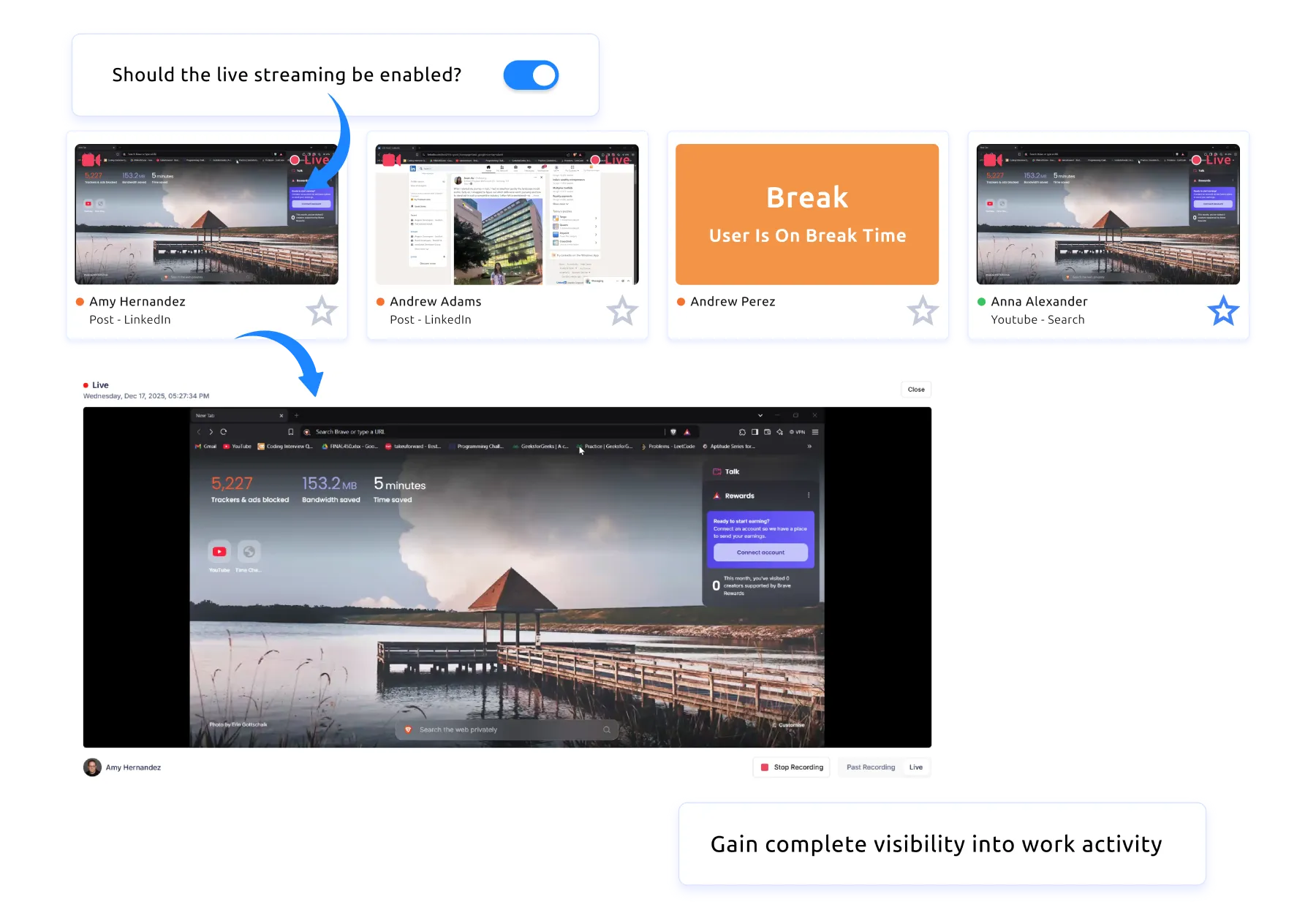
Screenshot capture frequency is adjustable from continuous down to intervals of 30 minutes or longer. Works councils commonly negotiate screenshot frequency as one of the first parameters, and E-Monitor supports any interval the agreement specifies.
Keystroke Logging On/Off
Keystroke activity intensity monitoring, which measures engagement levels without capturing content, can be disabled entirely per works council agreement. Many German and Dutch agreements exclude keystroke data specifically, and E-Monitor supports this exclusion.

Work-Hours-Only Monitoring Boundary
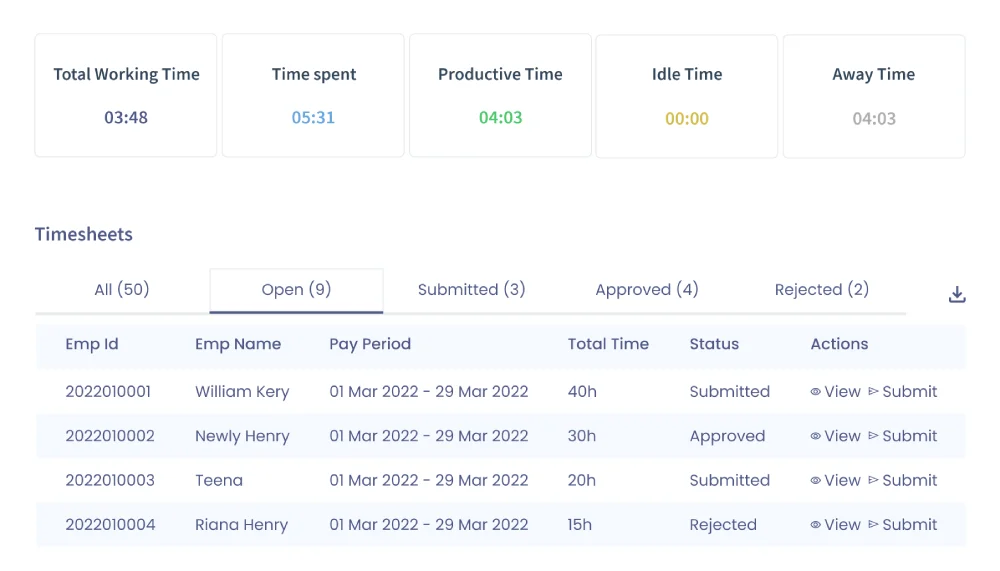
E-Monitor monitors only during active work sessions initiated by employee clock-in. This boundary directly addresses the most common works council concern about home office monitoring: that personal time is subject to employer observation. The boundary is technical, not just a policy statement.
Employee Self-Service Dashboard
Every employee accesses a personal dashboard showing all data collected about them. This employee transparency feature is a standard requirement in German Betriebsvereinbarungen and Dutch OR agreements, and it is built into E-Monitor's default configuration.
Role-Based Access Controls
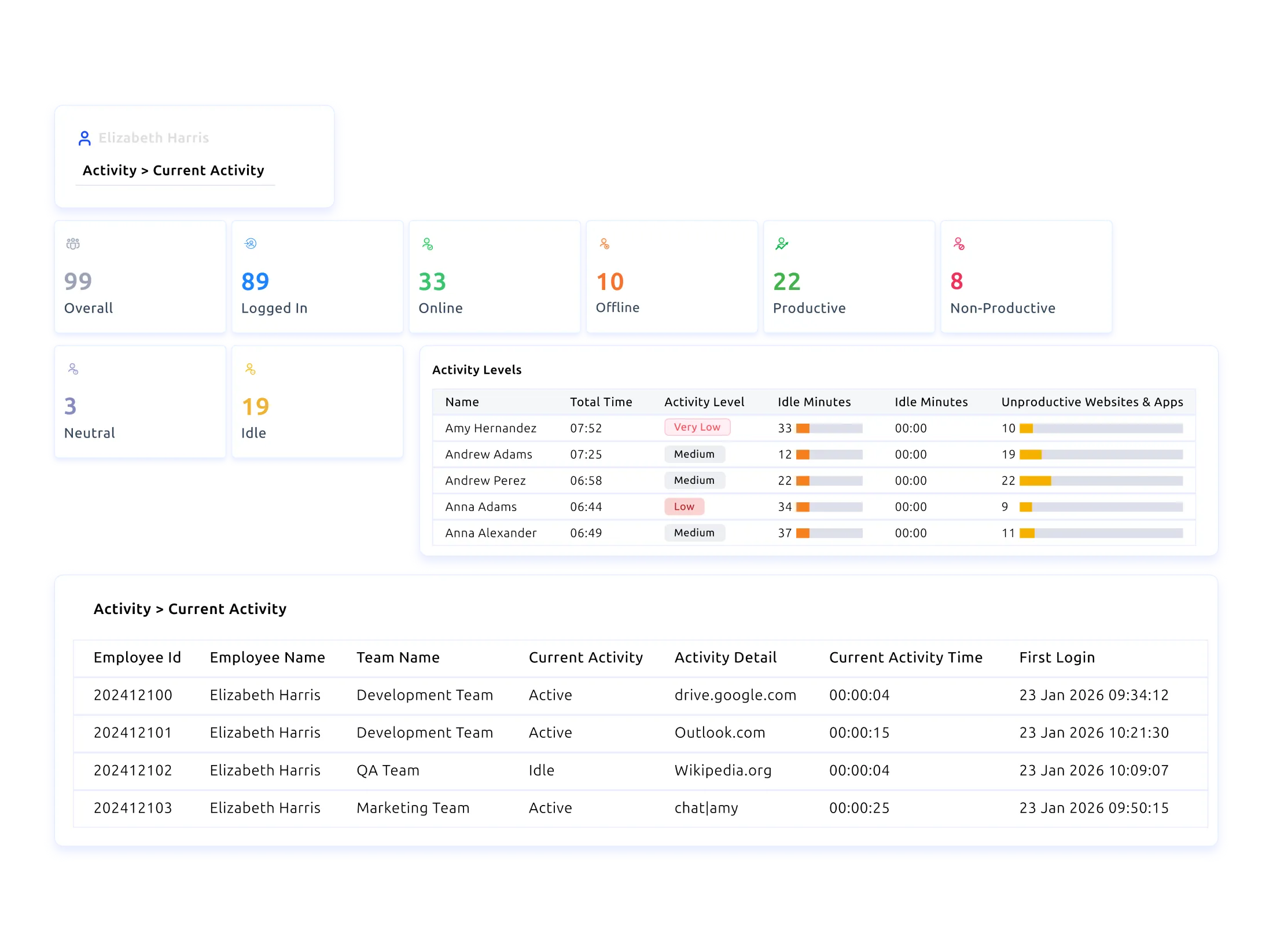
Access to monitoring data is configurable by management level. Works council agreements that specify which roles can view individual employee data, typically immediate supervisors and HR, with executive access requiring additional justification, are implementable in E-Monitor's permission structure without technical workarounds.
Configurable Data Retention
Data retention periods are configurable per the works agreement terms. Agreements that specify 90-day or 180-day maximum retention are enforceable in E-Monitor through retention policy settings, supporting compliance with the data minimization principle under GDPR.

Frequently Asked Questions: Employee Monitoring and European Works Councils
What is a works council and why does it affect employee monitoring?
A works council is a statutory employee representative body required by law in most EU member states once an organization reaches a minimum workforce size. Works councils hold statutory rights over management decisions that affect employees, including the introduction of employee monitoring systems. In Germany, France, and the Netherlands, employers cannot lawfully deploy monitoring software without completing the required works council process.
Does the German Betriebsrat have veto power over employee monitoring?
Yes. Under BetrVG Section 87(1)(6), the Betriebsrat has co-determination rights over technical monitoring devices. This is not a consultation right, it is a right of agreement. An employer cannot implement monitoring software in Germany without the Betriebsrat's written consent. Monitoring deployed without this consent is unlawful and subject to injunction.
What is the CSE consultation requirement for monitoring in France?
In France, the Comité Social et Économique must be consulted before an employer introduces any employee monitoring system. The CSE must receive sufficient information to provide a reasoned opinion. Deploying monitoring without CSE consultation renders monitoring evidence inadmissible in French employment tribunals and exposes the employer to unfair labor practice claims.
What approval does the Dutch Ondernemingsraad have over monitoring?
WOR Article 27 gives the Ondernemingsraad a right of approval (instemmingsrecht) over personnel monitoring systems. The employer must obtain OR approval before implementing any monitoring system. If the OR withholds approval, the employer must petition the court to override the refusal, which requires demonstrating compelling business necessity.
How early should consultation with a works council begin?
Works council consultation for employee monitoring should begin 3 to 6 months before the intended deployment date. German Betriebsrat processes are particularly time-intensive: the council has the right to request expert assistance at the employer's expense and can extend deliberation periods substantially. Beginning consultation early signals good faith and improves the probability of reaching agreement.
What documentation does a works council require to evaluate monitoring software?
Works councils typically require: a complete technical description of what data is collected, how it is stored and secured, who has access, data retention periods, a DPIA, the business justification for each feature, the proposed monitoring policy, and confirmation of which features will and will not be activated. E-Monitor's privacy documentation package covers each of these requirements.
Can a works council negotiate limits on what E-Monitor features are activated?
Yes, and this is the standard outcome of successful monitoring negotiations. Works council agreements typically specify screenshot frequency limits, whether keystroke logging is permitted, data retention periods, which management levels can access data, and prohibited uses of monitoring data. E-Monitor's configurable feature set supports this granular negotiation.
What is a European Works Council and when does it apply?
A European Works Council is required for multinationals with at least 1,000 EU employees and at least 150 employees in each of two or more member states. The EWC has transnational consultation rights. A company-wide monitoring deployment across multiple EU countries requires EWC consultation before national-level works council processes begin.
What happens if monitoring is deployed in Germany without Betriebsrat agreement?
Deploying monitoring without Betriebsrat agreement violates BetrVG Section 87(1)(6) and entitles the Betriebsrat to seek an injunction. Evidence gathered through unconsented monitoring is inadmissible in German employment proceedings, and the employer may face significant legal costs regardless of the underlying dispute.
How does E-Monitor's transparency design support works council negotiations?
E-Monitor's employee-facing dashboard, work-hours-only monitoring boundary, and configurable feature levels directly address the most common works council objections. The employee dashboard demonstrates that workers can see all data collected about them. Configurable features allow the works council to specify exactly which capabilities are activated, producing a negotiated monitoring scope rather than an all-or-nothing decision.
Get started
Deploy Monitoring That Works With Your Works Council, Not Against It
E-Monitor's configurable, transparent architecture is built to satisfy European works council requirements. Book a compliance consultation to start the process.
- 7-day free trial
- No credit card
- Live in minutes