
Employee Monitoring for Field Service Technicians: GPS, Job Verification, and Service Documentation
Monitoring field service technicians addresses the core challenge of managing a workforce you cannot see. E-Monitor's GPS tracking, job site verification, and time documentation give field service managers the operational visibility that an office manager takes for granted, and that field operations have historically had to manage without.
7-day free trial. No credit card required. Trusted by 1,000+ companies.
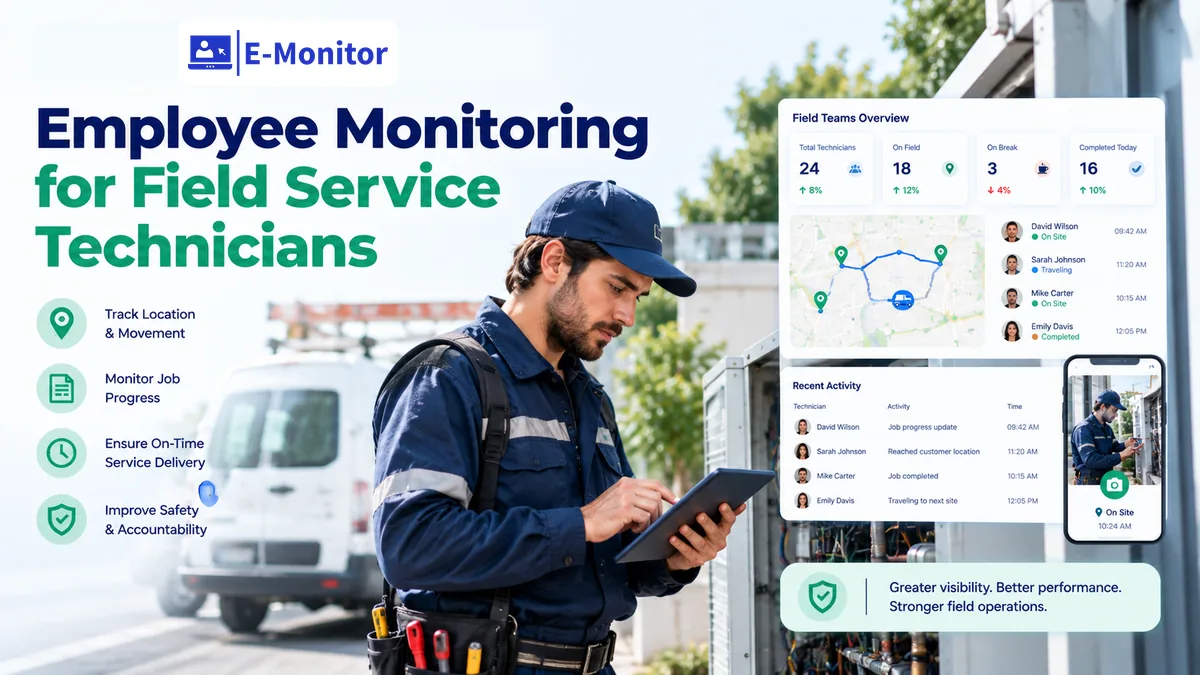
Why Is Managing Field Service Technicians Fundamentally Harder Than Managing Office Workers?
Monitoring field service technicians addresses a management visibility gap that has always existed in service industries: technicians work alone, at customer premises, often across a territory spanning dozens of miles. Their manager may not see them in person for days. Customer feedback is the primary quality signal, but it arrives after the fact, when it arrives at all.
The financial stakes of this visibility gap are substantial. Aberdeen Group research found that field service organizations with below-average first-time fix rates spend 67% more on repeat visits than best-in-class organizations. Inefficient routing alone costs the average field service organization $40,000-$60,000 per technician annually in unnecessary travel time (FieldAware / Service Council research, 2024). And the Association of Certified Fraud Examiners estimates that time theft costs employers approximately 4.5 hours per week per employee: in field service, where verification is difficult, this number is typically higher.
Field service management platforms track what jobs are scheduled and what technicians report. E-Monitor provides the layer underneath: where technicians actually were, when they arrived, how long they stayed, and what they did on their devices during service windows. This is not about distrust, it is about having the operational data to run a field service operation efficiently.
GPS Tracking Features for Field Service Operations
E-Monitor's GPS tracking provides the location layer that field service management requires. Here is how each capability maps to operational needs.
Real-Time Location and Job Site Arrival Confirmation
Dispatchers and service managers see each technician's current location on a live map. When a technician arrives at a job site, the GPS logs the arrival timestamp and triggers the geofence check against the configured site perimeter. This arrival confirmation serves multiple purposes: it timestamps billable time start, confirms the technician is at the correct address (not a nearby parking lot or coffee shop), and provides the foundation record for any later customer dispute about whether service was performed.
For organizations offering service windows ("your technician will arrive between 10 AM and 2 PM"), GPS tracking enables proactive customer communication when a technician is running behind, before the customer calls to complain. Dispatch can see that Technician A is still 35 minutes from the next job and proactively rebook or notify the customer. This single capability, consistently applied, has a measurable impact on customer satisfaction scores and repeat business rates.
Departure Timestamps and Service Duration Records
GPS departure timestamps document when a technician leaves a job site. Combined with arrival time, this creates a service duration record that is far more reliable than a technician's self-reported job completion time. For customer billing on time-and-materials contracts, service duration documentation supports invoice accuracy and reduces billing disputes. For recurring service contracts, duration trends reveal which technicians consistently under-serve or over-serve relative to the allotted time, enabling targeted coaching or contract adjustment.
Route and Travel History
Movement history between job sites is logged with continuous GPS coordinates, creating a complete picture of each technician's day. Route analysis reveals inefficiencies: technicians taking significantly longer routes than optimal, stopping at non-job-site locations during scheduled work hours, or returning to a home location in the middle of the day. Route optimization recommendations, even informal ones derived from comparing high-efficiency and low-efficiency technicians' routes, typically yield 15-20% reductions in daily travel time across a field team.
Geofencing for Complex Multi-Site Operations
For organizations with multiple service territories, technician zones, or restricted customer locations, geofencing provides automated boundary enforcement. Alerts fire when a technician enters or exits defined zones, when a company vehicle (tracked via mobile) leaves an authorized service area during work hours, or when a technician clocks in from outside their assigned territory. This is particularly valuable for organizations managing technicians across multiple states or regions with different labor law requirements.
What Is a Ghost Job, and How Does Monitoring Detect It?
A ghost job in field service is a service call that is logged as completed, by the technician, in the field service management platform, with the customer billed, but where the actual service was never performed, was performed inadequately, or was cut so short as to be meaningless. It is a form of time theft that is particularly difficult to detect without GPS and time data because the paperwork looks correct.
The Four Ghost Job Patterns
Ghost jobs typically present in one of four patterns, each visible in E-Monitor's GPS and activity data:
- Complete skip: Technician never visits the job site. GPS shows no location event at the customer address. The job is marked complete in the FSM platform from a location miles away.
- Drive-by: Technician drives past the customer location without stopping, or stops briefly in the parking area without entering. GPS shows a very short location event, 3-4 minutes, at a job scheduled for 45.
- Early departure: Technician arrives, marks the job complete after 15 minutes on a 60-minute job, and leaves. Service was partially performed. GPS departure timestamp and job completion timestamp are discordant with the service contracted.
- Documentation fraud: Technician completes a job but logs incorrect diagnostics, work performed, or parts used. Activity data showing which FSM application screens were accessed, and for how long, reveals whether the documentation was filled in legitimately or submitted as a one-minute entry after the fact.
The Customer Dispute Resolution Value
When a customer calls to dispute whether a technician performed the work, the employer has two options: accept the customer's account and send another technician (absorbing the cost), or defend the technician's completion report. Without GPS and time data, the employer cannot do the latter credibly. With E-Monitor, the employer can produce a timestamped GPS record showing the technician arrived at 10:47 AM, was present for 52 minutes, and departed at 11:39 AM, resolving the dispute with objective evidence rather than conflicting recollections.
Time Tracking and Labor Law Compliance for Field Technicians
Field service employers face significant wage and hour compliance risks. FLSA overtime requirements, state-specific daily overtime rules, travel time pay obligations, and the evidentiary demands of wage claims combine to make accurate time tracking a compliance necessity, not just an operational preference.
FLSA Requirements for Field Workers
The Fair Labor Standards Act requires employers to pay non-exempt field service technicians for all hours worked, including compensable travel time. The U.S. Department of Labor's definition of compensable travel time, particularly travel from the first job site to the last, minus the normal home-to-work commute, is nuanced and frequently litigated. E-Monitor's GPS travel time logging, combined with automated time tracking, creates the precise records needed to calculate compensable travel time accurately and defend against wage claims.
The DOL recovered over $274 million in back wages for overtime violations in fiscal year 2023, a significant portion from industries with mobile workforces. Field service employers who cannot produce accurate, contemporaneous time records are highly vulnerable in DOL audit scenarios.
California's Stricter Daily Overtime Requirements
California labor law requires overtime at 1.5x for hours beyond 8 in a single day (not just 40 in a week), double time for hours beyond 12 in a day, and overtime on the seventh consecutive day of a workweek. For HVAC, plumbing, electrical, and other trade contractors with California operations, these daily thresholds make hour-by-hour accuracy essential. E-Monitor's overtime alerts can be configured for California-specific rules, notifying dispatchers when a technician is approaching their daily threshold before overtime begins accruing.
Meal and Rest Break Compliance
Many states require documented meal and rest breaks for field workers. California requires a 30-minute unpaid meal break for shifts over 5 hours. E-Monitor's idle time detection captures extended device inactivity that typically corresponds to break periods, creating a documented record of break compliance without requiring technicians to manually clock in and out for every rest period. This documentation is invaluable during California Labor Commissioner investigations, where the burden of proof for break compliance falls on the employer.
Overtime Prevention Through Proactive Dispatch Management
Unplanned overtime is a significant cost driver in field service, a technician who gets dispatched to a late-afternoon emergency job that runs long can accumulate $80-100 in overtime costs in a single day. E-Monitor's alerts fire when technicians approach the 8-hour daily threshold (or 40-hour weekly threshold), giving dispatch the information they need to reassign or defer jobs before overtime accumulates. Organizations using proactive overtime management typically reduce unplanned overtime costs by 25-40%.
Field Service Monitoring Across Industries: Where It Makes the Biggest Impact
Field service monitoring applies across a wide range of industries, each with specific characteristics that determine which monitoring capabilities deliver the most value.
HVAC, Plumbing, and Electrical Trades
Residential service trades operate with wide service windows, high job volumes per day, and significant variation in job duration. GPS route optimization reduces drive time between jobs; departure timestamp monitoring detects early leavers; and activity data in the FSM app confirms job documentation was completed on-site rather than en masse. For multi-tech operations, E-Monitor's utilization data identifies which technicians are completing the most jobs per day and what their routing patterns look like, enabling peer coaching for lower-performing technicians.
Cable, Internet, and Telecom Installation
Telecom installation technicians are typically paid per job (piece rate) rather than hourly, but their employers still carry FLSA minimum wage obligations if piece-rate earnings fall below minimum wage thresholds. Accurate hour tracking is a compliance requirement regardless of pay structure. GPS data also supports installation quality claims, when a customer reports a failed installation, the GPS record confirms how long the technician spent on-site and whether the time was consistent with a proper installation procedure.
Home Healthcare and Medical Equipment Service
Home health aides and medical equipment technicians operate under heightened documentation requirements. Visit duration records, arrival and departure confirmation, and activity logs during visits provide the documentation needed for Medicare/Medicaid billing compliance and for responding to state health department audits. HIPAA considerations apply to any screen content captured during home healthcare visits, configure screenshot exclusions for applications displaying patient health information.
Equipment Repair and Industrial Services
Industrial field technicians often work on large, complex jobs across multi-day service events at customer facilities. Multi-day GPS and time records document total hours worked across extended engagements, supporting accurate billing and FLSA compliance for jobs that span multiple shifts. Activity logs in technical documentation systems confirm service procedures were followed and recorded, a quality assurance benefit beyond the workforce management use case.
Get started
Give Your Field Service Operation the Visibility It Deserves
GPS tracking, job verification, and FLSA-compliant time records, all from one platform. 7-day free trial, no credit card required.
- 7-day free trial
- No credit card
- Live in minutes
How E-Monitor Enriches Your Field Service Management Platform
Field service management platforms, ServiceTitan, Salesforce Field Service, Microsoft Dynamics Field Service, FieldEdge, Jobber, manage job scheduling, dispatch, customer communication, and invoicing. What they do not capture is behavioral data about what technicians are actually doing on their devices during service windows. E-Monitor adds this layer.
Behavioral Context for FSM Data
When a technician marks a job complete in ServiceTitan, the FSM platform records the completion. E-Monitor records what the technician was doing in the ServiceTitan application during the job, how long they spent in the job notes section, whether they accessed the parts catalog, how quickly the job was documented after arrival. This behavioral context reveals the difference between thorough, on-site documentation and rapid post-hoc entries made from the next job or from home.
Discrepancy Detection Between FSM and GPS Data
When a technician logs a job as starting at 9:00 AM in the FSM platform but GPS shows they did not arrive at the customer address until 9:22 AM, there is a discrepancy worth investigating. E-Monitor's time and location data creates an objective reference point against which FSM self-reported data can be compared. Systematic discrepancy patterns across a technician's history indicate a habit worth addressing; isolated discrepancies may have innocent explanations. The data allows managers to distinguish between the two.
Productivity Benchmarking Across the Technician Team
E-Monitor's productivity analytics enable comparison of activity patterns across the field team. Which technicians spend the most time in active service application use versus idle time during job windows? Which technicians complete documentation fastest, and does their documentation quality (as rated by FSM inspection workflows) correlate with documentation speed? These comparisons drive evidence-based coaching conversations that replace subjective performance assessments with objective behavioral data.
For context on monitoring workers who move between your offices and field locations, see monitoring employees at client sites. For broader mobile workforce management approaches, see remote team monitoring.
Balancing Oversight With Trust: Monitoring Technicians Transparently
Field service technicians who feel surveilled rather than supported become disengaged, which is the opposite of the goal. The framing and implementation of monitoring programs matters as much as the monitoring itself.
What Monitoring Is: and Is Not
E-Monitor monitors company-owned devices during work hours. GPS tracking deactivates after clock-out. Personal device activity is never monitored. After-hours movements are not recorded. The monitoring scope is precisely what the employer needs for legitimate operational and compliance purposes, and nothing more. Communicating this scope clearly to technicians is the first step toward a monitoring program they accept rather than resent.
Employee Dashboard Transparency
Every technician monitored by E-Monitor can see their own data, their GPS route history, their job site arrival times, their hours worked. This transparency converts monitoring from something done to technicians into something they can use to understand and improve their own performance. A technician who can see that their average travel time between jobs is 23% higher than their team's median has objective data for a self-improvement conversation that a subjective manager observation could never provide as cleanly.
Using Data for Coaching, Not Discipline
The most effective field service monitoring programs use data primarily for positive outcomes: identifying route optimization opportunities, recognizing high performers, uncovering training needs that coaching can address, and removing administrative barriers that waste technician time. The punitive use of monitoring data, disciplining technicians for being 10 minutes late to a job, erodes trust without producing the behavioral change that genuine coaching achieves. Establish the use-of-data policy alongside the monitoring policy, so technicians know what the data will be used for.
Frequently Asked Questions: Monitoring Field Service Technicians
How does GPS monitoring help manage field service technicians?
GPS monitoring provides real-time location visibility for field technicians, confirming they are at the correct job site during scheduled service windows. Arrival and departure timestamps are logged automatically, creating an auditable record that supports both customer billing and FLSA compliance. Route tracking between jobs enables dispatch optimization and reduces unnecessary travel time across the service team, with top organizations reporting 15-25% improvement in jobs completed per day.
What is a ghost job in field service, and how does monitoring prevent it?
A ghost job occurs when a technician records a service call as completed but does not actually perform the work. GPS location data combined with job site arrival and departure timestamps creates an objective record that either confirms presence for the expected duration or documents a discrepancy. Systematic ghost job patterns become visible in route and time analytics over time, enabling managers to address the issue before it compounds into significant customer satisfaction and revenue loss.
Can E-Monitor integrate with field service management platforms like ServiceTitan?
E-Monitor monitors activity at the device level, capturing interactions with any application including ServiceTitan, Salesforce Field Service, Microsoft Dynamics, and other FSM platforms. The behavioral data enriches FSM records with a confirmation layer, showing how long technicians spent in job documentation, whether they accessed the correct screens, and whether documentation was completed on-site or submitted later from another location.
How does monitoring help with FLSA compliance for field service workers?
The FLSA requires employers to pay non-exempt field workers for all hours worked, including compensable travel time between job sites, and overtime beyond 40 hours weekly. E-Monitor's automated time tracking captures total work hours, travel time, and overtime accumulation with tamper-resistant timestamps. The DOL recovered $274 million in field worker back wages in fiscal 2023, precise time records are the primary protection against wage claims and audit liability.
How can customers verify that a technician actually performed the work claimed?
E-Monitor creates a timestamped record of when the technician arrived at the job site, how long they were present, and what device activity occurred during the service window. For customer disputes, the employer can produce GPS-verified site attendance records showing the technician's precise arrival and departure times, resolving disputes with objective evidence rather than conflicting recollections between the technician and the customer.
What are California's specific overtime requirements for field service technicians?
California requires overtime at 1.5x for hours beyond 8 in a single day (not just 40 weekly), double time for hours beyond 12 in a day, and overtime on the seventh consecutive workday. These daily thresholds make hour-by-hour accuracy essential for California field service employers. E-Monitor's configurable overtime alerts enforce California-specific thresholds and notify dispatchers when technicians approach daily overtime limits before costs accrue.
How does monitoring reduce no-shows and late arrivals for service appointments?
GPS location tracking alerts dispatch when a technician is not approaching their next job site within the expected timeframe. Proactive alerts give dispatchers time to contact the technician, redistribute the job, or notify the customer, rather than discovering a no-show only after the customer calls. Technicians aware that GPS tracks schedule adherence show significantly improved punctuality and arrival rates over time.
Does monitoring for field service technicians respect privacy?
E-Monitor monitors company-owned devices during work hours only. GPS tracking deactivates after clock-out. Personal device activity and after-hours movements are never monitored. Employees access their own tracking data through personal dashboards, maintaining transparency about what is captured. The monitoring scope is limited to what is necessary for legitimate business purposes: job site verification, work hours, and service documentation.
How does time theft present in field service teams?
Field service time theft takes three main forms: leaving job sites early while logging the full scheduled duration, logging lunch breaks as work time, and billing travel time to personal errands. GPS location data combined with time tracking creates objective visibility into each pattern. Departure timestamps document early leavers; activity logs during transit document non-work stops; and clock-in accuracy is verified against GPS location records for each job transition.
What is the typical efficiency improvement after deploying monitoring for field technicians?
Organizations deploying GPS and time monitoring for field service teams typically report 15-25% improvements in jobs completed per day as route optimization and reduced idle time take effect. Aberdeen Group research found that best-in-class field service organizations achieve 88% first-time fix rates versus 63% for average performers, and monitoring-informed dispatch decisions are a key differentiator in reaching that benchmark.
Get started
Bring Real Visibility to Your Field Service Operations
GPS verification, ghost job detection, FLSA-compliant time records, everything your field service team needs to operate efficiently and compliantly. Trusted by 1,000+ companies. 7-day free trial.
- 7-day free trial
- No credit card
- Live in minutes