
Summary
Free tools cover real use cases, individual productivity, small-team time tracking, open-source self-hosted control. They don't replace paid monitoring at scale. Here are the 8 best free and open source employee monitoring software options worth considering, and what each one actually does.
Want full monitoring with nothing to configure? E-Monitor starts at $3.90 per user per month with a 7-day free trial. Try E-Monitor free →
Quick Comparison Table
| # | Tool | Type | Best for | Limit / cost | G2 rating |
|---|---|---|---|---|---|
| 1 | E-Monitor | Full-featured monitoring (7-day free trial) | Try-before-buy, activity + DLP | Free 7 days, then $3.90/user | 4.7 / 5 |
| 2 | Time Champ | Paid SaaS platform (7-day free trial) | Full monitoring and DLP | Free 7 days, then $3.90/user/mo | 4.9 / 5 |
| 3 | ActivityWatch | Open source | Self-hosted personal/team activity | Free, self-hosted | 4.5 / 5 |
| 4 | Kimai | Open source | Self-hosted timesheet | Free, self-hosted | 4.4 / 5 |
| 5 | Toggl Track Free | SaaS free tier | 5-user time tracking | Free up to 5 users | 4.6 / 5 |
| 6 | TimeCamp Free | SaaS free tier | Unlimited-user time + projects | Free unlimited users | 4.6 / 5 |
| 7 | Tockler | Open source | Personal activity tracking | Free desktop app | 4.0 / 5 |
| 8 | Workrave | Open source | RSI break reminders | Free desktop | 4.2 / 5 |
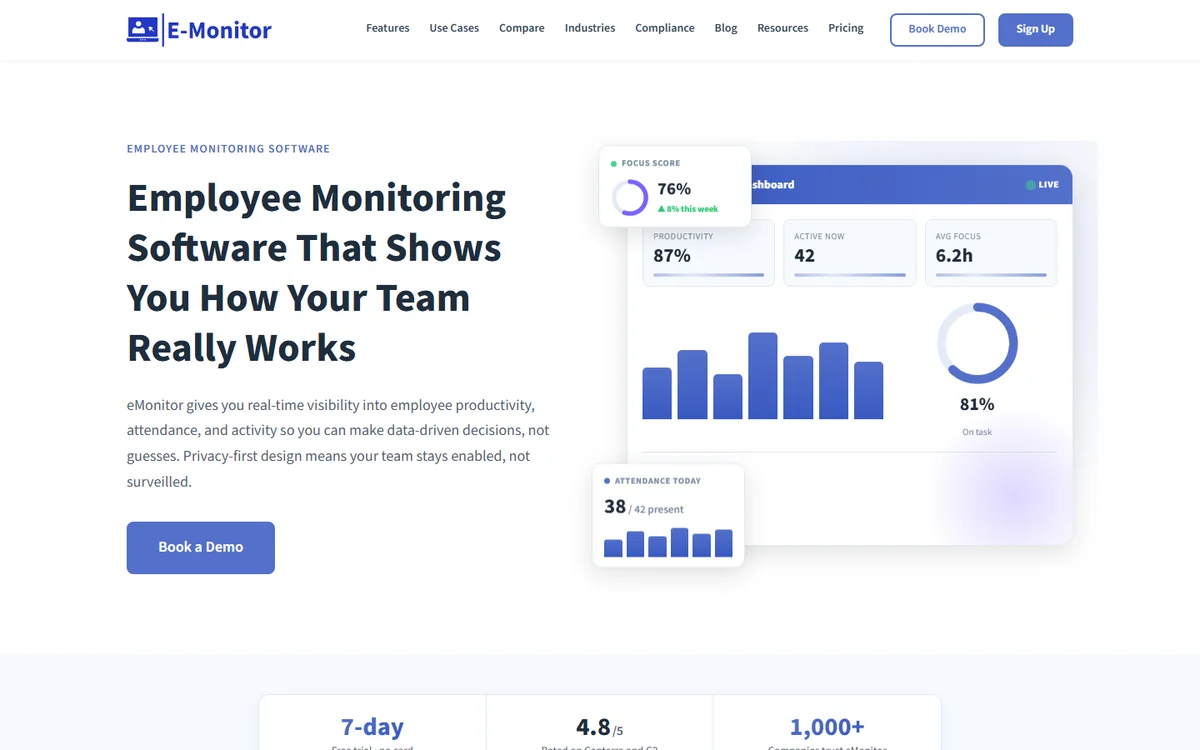
1. E-Monitor: Full-Featured Monitoring on a 7-Day Free Trial
Compare: E-Monitor pricing · all features
If "free" is really "evaluate before paying," E-Monitor's 7-day trial gives full access to enterprise-grade monitoring at no cost. After the trial, $3.90/user/month, the lowest-priced full-monitoring tier in the market.
Best for: teams evaluating paid monitoring before committing.
G2 rating: 4.7 / 5
2. Time Champ: AI-Powered Monitoring on a 7-Day Free Trial
Compare: E-Monitor vs Time Champ
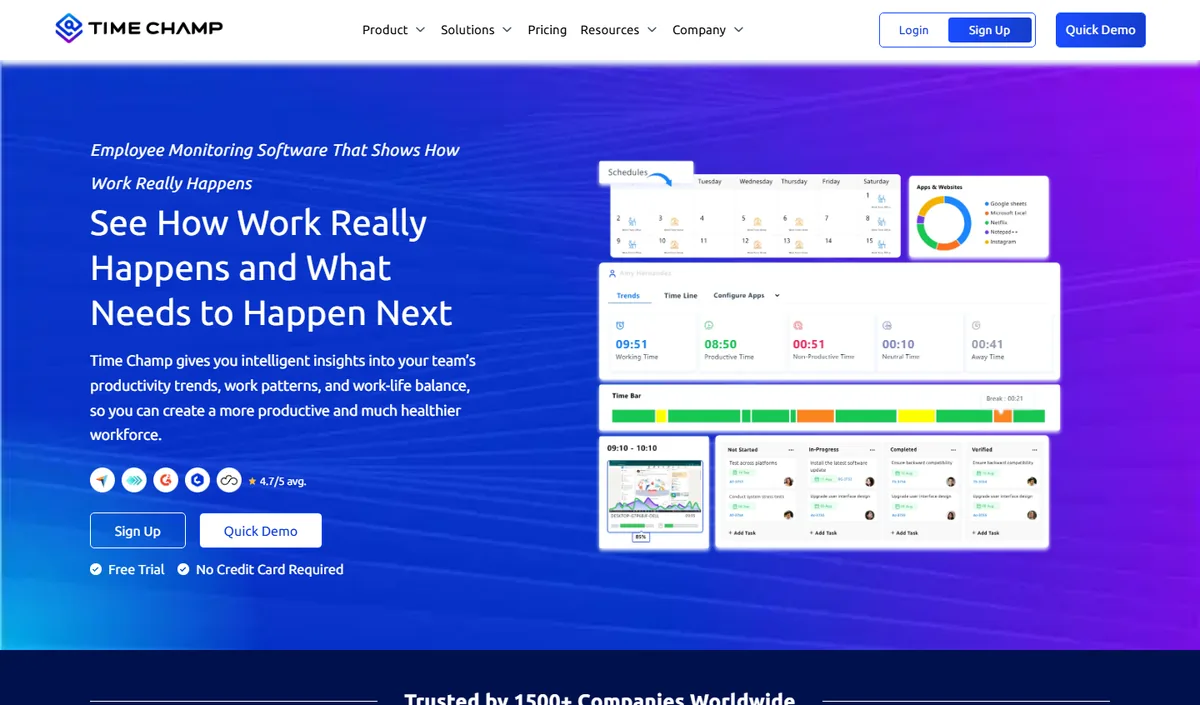
Time Champ is AI-powered employee monitoring software worth knowing when a team outgrows free or open-source tools that need self-hosting and ongoing upkeep. It delivers monitoring, time tracking, attendance, and data loss prevention as a managed platform, without the maintenance burden of a self-run stack.
Key features: Screenshots and screen recording, app and website tracking, AI productivity scoring, time tracking with automatic timesheets, attendance and scheduling, and data loss prevention with USB and file-transfer monitoring.
Pricing: Free 7-day trial with no credit card required, then Starter $3.90, Professional $6.90, Enterprise $13.90 per user per month (annual billing).
G2 rating: 95% satisfaction on G2 (4.9 / 5 on Capterra, 13 reviews).
Pros: AI-native productivity scoring and anomaly detection; one platform for monitoring, time tracking, attendance, and DLP; transparent, employee-facing dashboards; affordable, with a free trial; responsive support and a 4.9 / 5 Capterra rating.
Cons: Generates payroll-ready exports rather than running payroll; no built-in video conferencing or CRM; smaller brand presence in Western markets than some incumbents; the platform breadth can exceed what very small teams need.
3. ActivityWatch: Open-Source Self-Hosted Activity
ActivityWatch is the leading open-source automatic activity tracker. Cross-platform (Windows, macOS, Linux), MIT-licensed, with active development. Data stays on your machine; nothing leaves unless you push it.
Best for: developers, privacy-focused individuals, small open-source-friendly teams.
Limits: no team dashboards built-in; you'd build your own aggregation. Self-hosting overhead.
G2 rating: 4.5 / 5
4. Kimai: Open-Source Timesheet
Kimai is a mature open-source timesheet application, self-hosted, designed for freelancers and agencies. Strong export options for invoicing.
Best for: agencies and freelancers comfortable with self-hosting; teams in data-residency-strict jurisdictions.
Limits: manual time entry primarily; no automatic activity tracking; admin overhead.
G2 rating: 4.4 / 5
5. Toggl Track Free: 5-User Time Tracking
Compare: Toggl Track alternatives
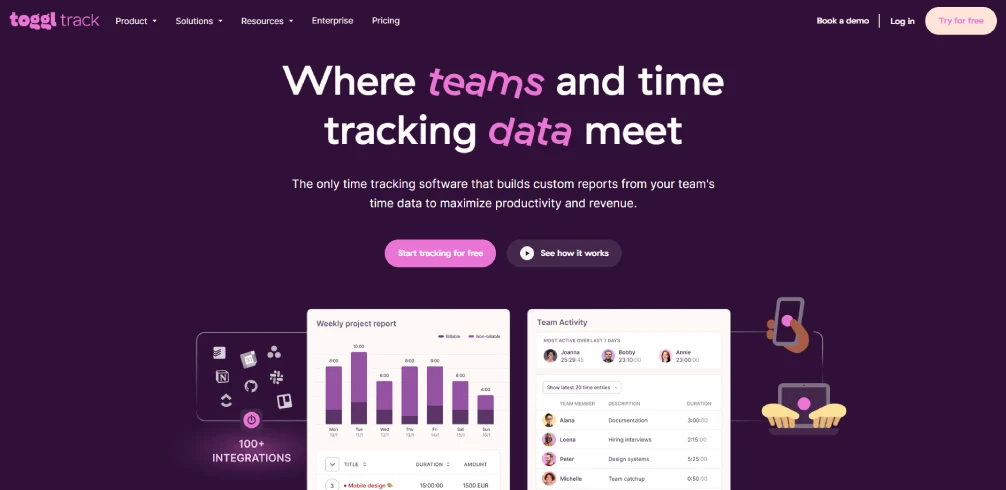
Toggl Track's free tier covers up to 5 users with the same UX as the paid tiers. Often the right pick for solo founders and tiny teams.
Best for: solo and 2-5 person teams.
Limits: 5-user cap; no advanced reporting on free; no activity monitoring.
G2 rating: 4.6 / 5
6. TimeCamp Free: Unlimited Users + Projects
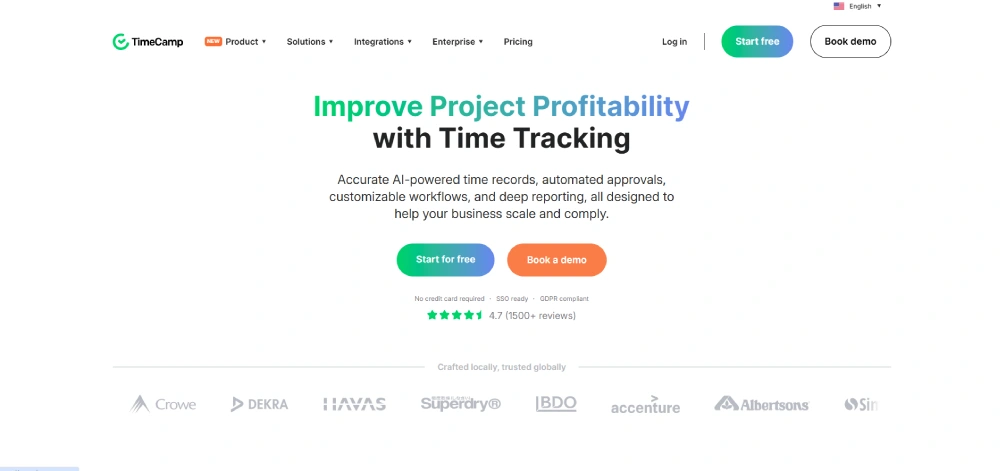
TimeCamp's free tier offers unlimited users with basic time tracking and project assignment. Strong value if you can live without integrations.
Best for: small teams needing time + project tracking on a zero budget.
Limits: integrations locked to paid; advanced reporting paid.
G2 rating: 4.6 / 5
7. Tockler: Personal Activity Tracking
Tockler is an open-source desktop app that tracks application activity locally on your machine. Useful for individuals who want to see their own time-on-tool breakdown without uploading anywhere.
Best for: individuals tracking personal productivity privately.
Limits: single-user; desktop-only; no team features.
G2 rating: 4.0 / 5
8. Workrave: RSI Break Reminders
Workrave isn't monitoring in the traditional sense, it's a free desktop tool that prompts breaks to prevent repetitive strain injury. Worth knowing for individual well-being use cases.
Best for: individuals concerned about RSI/computer wellness.
Limits: single-user; no productivity tracking.
G2 rating: 4.2 / 5
When Free Is Enough: and When It Isn't
Free works for: individuals, 2-5 person teams, time-tracking-only use cases, data-residency-strict jurisdictions willing to self-host.
Free breaks down at: 15+ employees, activity monitoring needs, integration-heavy stacks, compliance use cases requiring audit-grade retention.
For deeper free-vs-paid decision logic, see open-source employee monitoring guide.
Frequently Asked Questions
1. Fully free monitoring tools?
ActivityWatch (open source). Clockify and TimeCamp have unlimited-user free tiers. Toggl Track free for 5 users. Kimai is open-source timesheet. None match paid-tool activity depth.
2. What's the catch?
Limited activity tracking, self-hosting overhead, limited team management. Works for small/individual use; doesn't scale.
3. Is open-source secure?
Self-hosted can be more secure than SaaS, data stays on your infrastructure. Trade-off: you operate the security yourself.
4. Can open-source scale to 50 people?
ActivityWatch and Kimai can but require self-hosting maintenance. Most teams past 30 find paid tools cheaper than staff time.
5. Free-tier limits from paid tools?
Capped users, no activity monitoring, no integrations, limited reporting. Designed to encourage upgrade at scale.
Ready for More Than Time Tracking? Try E-Monitor free for 7 days. Activity tracking, productivity analytics, DLP, capacity planning, all included. Sign up →

