
Summary
Syteca alternatives are employee monitoring platforms that provide insider threat detection, activity logging, and compliance evidence for the general workforce, without the PAM-specific complexity and cost of Syteca's privileged access management architecture. If you are looking for session recording and behavioral analytics for your whole team, not just your IT admins, this guide covers the seven best options available in 2026, ranked by value and deployment simplicity.
Want full monitoring with nothing to configure? E-Monitor starts at $3.90 per user per month with a 7-day free trial. Try E-Monitor free →
Why Are Organizations Looking for Syteca Alternatives?
Syteca, formerly known as Ekran System, is genuinely good at what it was built for: session recording and access management for privileged IT accounts. Security teams use it to monitor what administrators do when they log into servers, databases, and network devices. That is a legitimate and important use case.
The problem arises when organizations deploy Syteca for their general workforce. Most employees are not privileged users. They are sales reps, analysts, customer support agents, finance teams, and remote workers. They do not need PAM-grade session recording. They need a monitoring platform that tracks productivity, flags unusual behavior, protects data from leaving the organization, and produces compliance evidence, without the licensing structure, infrastructure requirements, and administrative overhead that comes with PAM software.
The Ponemon Institute's 2023 Cost of Insider Threats report found that the average cost of an insider threat incident reached $16.2 million: a figure that spans both malicious and negligent actors. Critically, 56% of incidents were caused by employee negligence, not malicious insiders. Negligent behavior, clicking phishing links, emailing sensitive files to personal accounts, misconfiguring shared drives, does not require PAM-level forensics to detect. A well-configured activity logging platform surfaces these patterns before they become incidents.
The buyers searching for Syteca alternatives typically fall into one of three categories:
- Organizations that evaluated Syteca and found the PAM architecture over-engineered and over-priced for their general employee population
- Current Syteca users looking for a more accessible tool for their non-IT workforce, potentially running alongside Syteca for privileged accounts
- Security or compliance teams that need insider threat evidence and audit trails but have already solved the PAM problem with a dedicated tool
This guide addresses all three. We have evaluated each alternative on deployment simplicity, insider threat detection capability, DLP features, pricing transparency, and suitability for non-privileged workforce monitoring.
Syteca Alternatives at a Glance: 2026 Comparison Table
The table below summarizes the key differentiators across all seven tools reviewed in this guide. Scroll down for the full breakdown of each platform.
| Tool | Starting Price | Best For | Insider Threat Detection | DLP | Deployment Complexity | PAM Required |
|---|---|---|---|---|---|---|
| E-Monitor | $3.90/user/mo | Full-workforce monitoring, SMB to enterprise | Yes, behavioral alerts + anomaly detection | Yes, USB, file, web | Very low, 2-min setup | No |
| Time Champ | Per user (vendor site) | Full-workforce monitoring, SMB to enterprise | Yes, behavioral alerts + anomaly detection | Yes, USB, file, web | Very low, 2-min setup | No |
| Teramind | $15+/user/mo | Mixed workforce with security-first focus | Yes, UEBA + behavioral rules | Yes, advanced | Moderate | No |
| ActivTrak | $10+/user/mo | Productivity-first buyers, lighter security needs | Partial, productivity anomalies | Limited | Low | No |
| CurrentWare | $3–$5/user/mo | Web filtering + access control without PAM costs | Partial, web/USB policy violations | Yes, web + USB | Low | No |
| Veriato | $25+/user/mo | Deep forensic investigation, high-risk environments | Yes, deep forensic logs | Yes, advanced | High | No |
| Forcepoint Insider Threat | Enterprise pricing | UEBA-focused security teams needing DLP + monitoring | Yes, UEBA + risk scoring | Yes, enterprise-grade | High | No |
| Varonis | Enterprise pricing | Data access governance + user behavior analytics | Yes, data access anomalies | Yes, data-centric | High | No |
| Syteca (Reference) | $9–$15+/user/mo | Privileged user session recording, IT admin monitoring | Yes, session-focused | Partial | High, PAM architecture | Yes |
1. E-Monitor: Best Overall Syteca Alternative for the General Workforce
Compare: E-Monitor pricing · all features
Starting price: $3.90/user/month
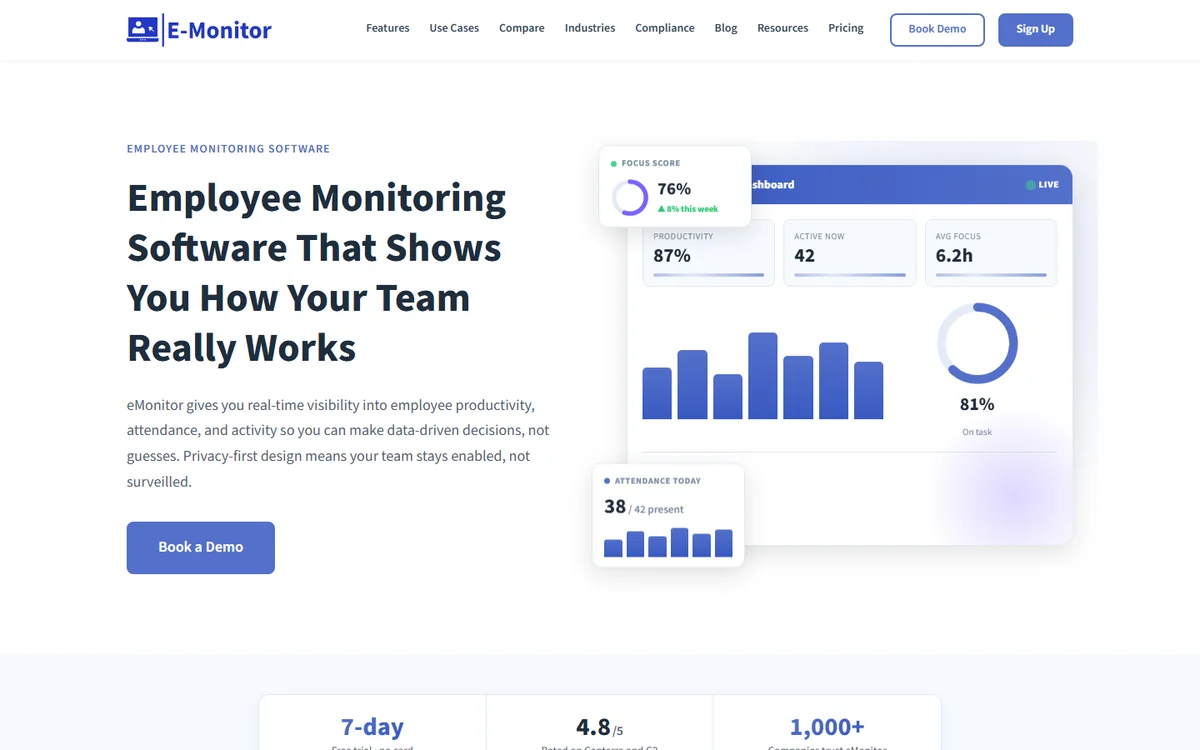
E-Monitor is the strongest all-around replacement for Syteca when your goal is monitoring the general workforce, not privileged IT accounts. Where Syteca's architecture is built around session recording for administrators, E-Monitor is purpose-built for full-workforce visibility: tracking every employee's activity, flagging unusual behavior, and generating the compliance evidence your auditors actually ask for.
At $3.90/user/month, E-Monitor delivers capabilities that overlap directly with what most organizations use Syteca for: comprehensive activity logging, screen monitoring with configurable screenshot frequency, USB and file transfer monitoring, and real-time behavioral alerts. The platform requires no PAM infrastructure. Deployment takes under two minutes per endpoint, and the monitoring scope applies to every employee, not just those with elevated privileges.
IBM's 2024 Cost of a Data Breach Report put the global average breach cost at $4.88 million, with insider incidents consistently ranking among the most expensive to remediate. E-Monitor's approach to insider threat detection is behavioral rather than forensic: it identifies the patterns that precede incidents, large file uploads, unusual off-hours activity, sudden spikes in USB usage, and alerts managers before damage occurs. This is precisely the use case that most organizations deploying Syteca for non-IT staff are actually trying to solve.
Key Features
- Real-time activity monitoring across all apps, websites, and files
- Automated screenshots at configurable intervals (every 1–30 minutes)
- Live screen viewing (see any employee's screen in real time)
- USB insertion monitoring with instant alerts and block capability
- File creation, modification, and deletion logging with full audit trails
- Upload and download violation alerts with domain and timestamp records
- Behavioral anomaly detection with configurable alert thresholds
- Role-based access control, only authorized managers see monitoring data
- Encrypted, tamper-proof data storage for compliance evidence
- Employee-facing dashboards (transparency by design)
Pricing
- Starter: $3.90/user/month, core monitoring, activity logs, screenshots
- Professional: $6.90/user/month, adds DLP, advanced alerts, screen recording
- Enterprise: $13.90/user/month, adds advanced analytics, priority support, SSO
Pros
- Purpose-built for general workforce monitoring, not PAM overhead
- Lowest cost among full-featured alternatives at $3.90/user/month
- 2-minute deployment with no infrastructure changes required
- Full DLP suite at the Professional tier ($6.90/user/month)
- Transparent employee dashboards reduce trust friction
- Rated 4.8/5 on Capterra across 57 reviews
Cons
- Does not replace PAM for privileged account session recording
- No built-in PAM integration module for hybrid deployments
Best for: SMBs and mid-market organizations (50–5,000 employees) that need insider threat detection, DLP, and activity audit trails for their general workforce without the cost or complexity of PAM software. Also strong for organizations already using a dedicated PAM tool who need a separate, more accessible layer for non-privileged users.
See how E-Monitor compares directly: E-Monitor vs Syteca, Full Feature Comparison
Insider Threat Detection Without PAM Complexity E-Monitor deploys in 2 minutes and monitors your entire workforce, not just privileged accounts, starting at $3.90/user/month. Sign up →
2. Time Champ: Best for AI-Powered Productivity Analytics and Attendance
Compare: E-Monitor vs Time Champ
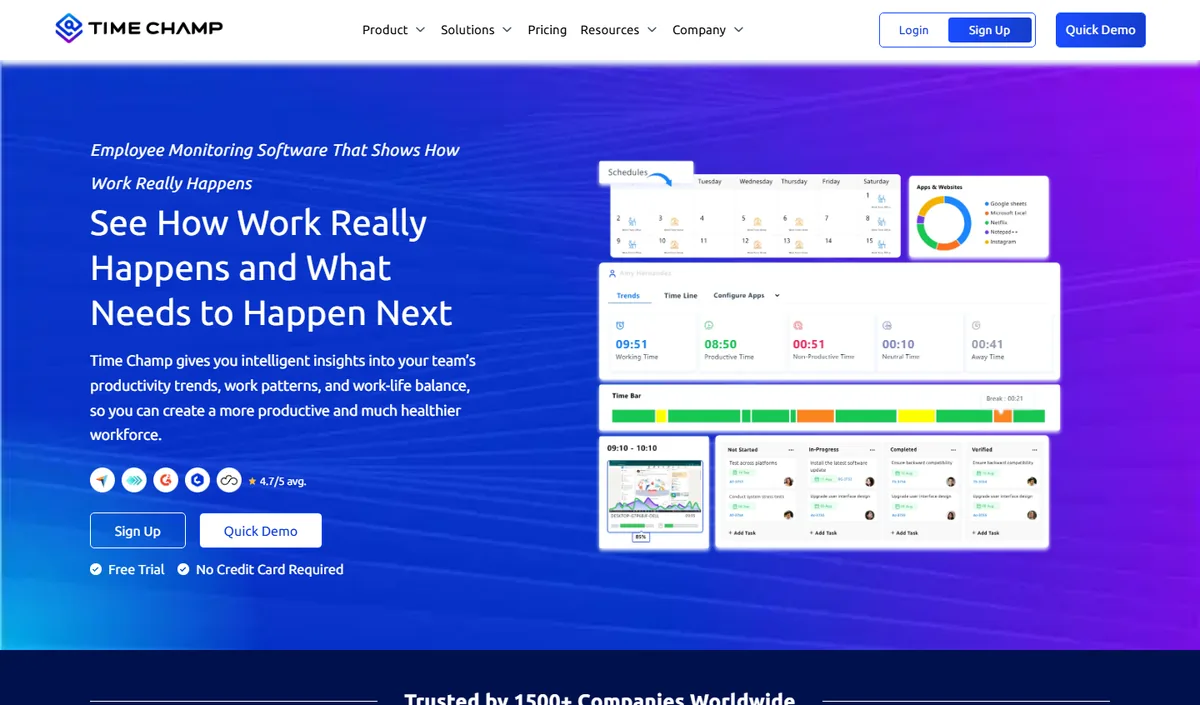
Time Champ is an AI-powered employee monitoring and productivity platform that combines automatic time tracking, application and website usage, productivity scoring, configurable screenshots, attendance and shift tracking, and dashboards at individual, team and company level. It runs on Windows, macOS and Linux and comes from the same product family as E-Monitor, so teams looking for an alternative to Syteca get comparable monitoring depth with a heavier emphasis on analytics and reporting.
Key features: automatic time tracking, app and website categorisation, productivity scoring with weekly heat maps, configurable screenshots, attendance and shift management, leave and payroll modules, role-based dashboards for managers and employees.
Best for: mid-size and larger teams, BPO and operations-heavy organisations that want deep analytics alongside monitoring.
Pricing: per-user plans published on the Time Champ website, with a free trial.
Limitation: cloud-hosted only, and more capability than a very small team may use; review the data-residency options before committing.
3. Teramind: Best for Security-First Mixed Workforce Monitoring
Compare: E-Monitor vs Teramind · Teramind alternatives
Starting price: $15+/user/month
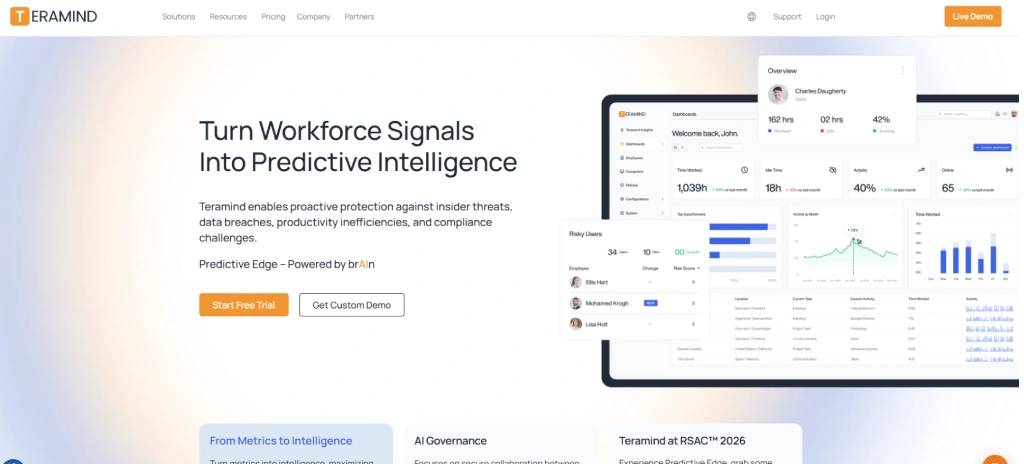
Teramind is the closest functional analog to Syteca among general employee monitoring tools. Where Syteca records privileged sessions, Teramind records and analyzes behavior across all user types, and does so with a security-team-focused feature set that includes User and Entity Behavior Analytics (UEBA), behavioral policy rules, and a DLP module comparable in depth to enterprise security platforms.
The platform is particularly strong for organizations with mixed security requirements: a financial services firm managing both customer-facing analysts and IT infrastructure staff, for example. Teramind handles both populations within a single deployment, applying different monitoring intensity and policy rules by role. This makes it a genuine alternative for organizations that evaluated Syteca and liked its depth but need it to extend beyond privileged accounts.
Key Features
- UEBA engine with baseline behavioral profiling per user
- Policy-based alerts with automated response actions (block, warn, record)
- Screen recording with anomaly-triggered capture
- Advanced DLP with content inspection across email, web, and file transfers
- Application and website monitoring with productivity classification
- Keystroke logging with application-level separation
- Full audit trail with forensic-grade log retention
Pricing
- Starter: $15/user/month (billed annually, 5-user minimum)
- UAM (User Activity Monitoring): $25/user/month
- DLP: $30/user/month
Pros
- UEBA depth closest to Syteca among general monitoring tools
- Sophisticated behavioral policy engine with automated responses
- Strong compliance reporting for regulated industries
- Single platform for mixed-risk workforce populations
Cons
- Significantly more expensive than E-Monitor or CurrentWare
- Steeper learning curve and longer deployment time
- Can feel over-engineered for organizations with straightforward monitoring needs
- Minimum seat requirements may not suit smaller teams
Best for: Enterprise security teams and regulated industries (financial services, healthcare, government contractors) that need UEBA-grade behavioral analytics across their entire workforce, not just privileged accounts. Organizations for whom depth of forensic capability outweighs cost considerations.
4. ActivTrak: Best for Productivity-First Buyers With Lighter Security Requirements
Compare: E-Monitor vs ActivTrak · ActivTrak alternatives
Starting price: $10+/user/month
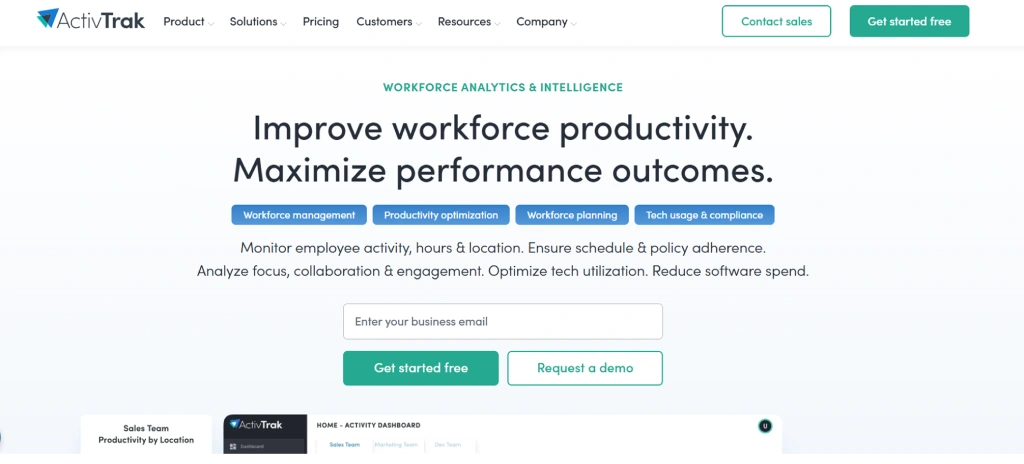
ActivTrak occupies a different part of the market than Syteca. Where Syteca prioritizes security forensics, ActivTrak is fundamentally a productivity analytics platform that surfaces anomalies as a secondary capability. If your primary concern coming out of a Syteca evaluation is "I need workforce visibility and productivity data" rather than "I need deep insider threat forensics," ActivTrak is worth considering.
The platform's strength is its analytics layer. ActivTrak's Workforce Insights dashboards give managers a clear picture of how time is spent, where productivity drops, and which workflows create bottlenecks. The platform also identifies behavioral anomalies, unusual working hours, sudden drops in productivity, atypical app usage, that can signal insider risk without the forensic depth of Syteca or Teramind.
Key Features
- App and website usage tracking with productivity classification
- Workforce Insights dashboards with team and individual analytics
- Productivity anomaly detection with alert capabilities
- Goal-setting and productivity benchmarking per employee
- Workload analysis to identify overworked or underutilized staff
- Coaching reports for manager conversations
Pricing
- Essentials: $10/user/month
- Professional: $17/user/month
- Enterprise: Custom pricing
Pros
- Excellent productivity analytics and coaching tools
- Clean, accessible interface with low management overhead
- Good for organizations prioritizing productivity over security forensics
- Transparent employee experience, designed to be non-adversarial
Cons
- Limited DLP capabilities, no USB monitoring, limited file transfer controls
- Not a direct replacement for Syteca's security forensics layer
- No screen recording at standard tiers
- Higher price than E-Monitor for less monitoring depth
Best for: Organizations that evaluated Syteca primarily for productivity visibility rather than security forensics. HR teams, operations leaders, and managers who want workforce analytics with basic behavioral anomaly detection, and are willing to sacrifice forensic depth for a better employee experience.
5. CurrentWare: Best for Web Filtering and Access Control Without PAM Costs
Starting price: $3–$5/user/month
CurrentWare is a suite of endpoint security tools targeting a specific subset of what Syteca does: controlling and logging what employees access on the web and on removable storage. If your core concern coming from Syteca is data exfiltration through browsers and USB devices, without the need for session recording or full activity monitoring, CurrentWare offers a focused, affordable answer.
The suite consists of four modules that can be purchased individually or bundled: BrowseReporter (web activity monitoring), BrowseControl (web filtering and blocking), AccessPatrol (USB and device control), and enPowerManager (remote desktop power management). Organizations can license only the components they need, which keeps costs very competitive, often $3–$5/user/month for the modules relevant to insider threat prevention.
Key Features
- Web activity logging with categorized reports
- Configurable web filtering by category, keyword, or specific domain
- USB and removable storage device control (allow, block, or read-only)
- File transfer logging with device identification
- User and group-based policy assignment
- Scheduled and on-demand reports for compliance evidence
Pricing
- BrowseReporter: ~$3.99/user/month
- BrowseControl: ~$3.99/user/month
- AccessPatrol: ~$3.99/user/month
- Bundle discounts available for multiple modules
Pros
- Very affordable for the specific controls it provides
- Modular, pay only for what you need
- Strong web filtering and USB control capabilities
- Straightforward deployment for Windows environments
Cons
- No screen monitoring or screenshot capabilities
- Limited productivity analytics compared to E-Monitor or Teramind
- Less comprehensive behavioral anomaly detection
- Primarily Windows-focused; limited macOS support
Best for: Organizations with a narrow insider threat use case centered on web access and removable storage. Ideal for regulated industries that need to document and control data exfiltration vectors without a full employee monitoring deployment. Also good as a complementary tool alongside a productivity-focused platform.
6. Veriato (Awareness Technologies): Best for Deep Forensic Investigation
Compare: E-Monitor vs Veriato · Veriato alternatives
Starting price: $25+/user/month
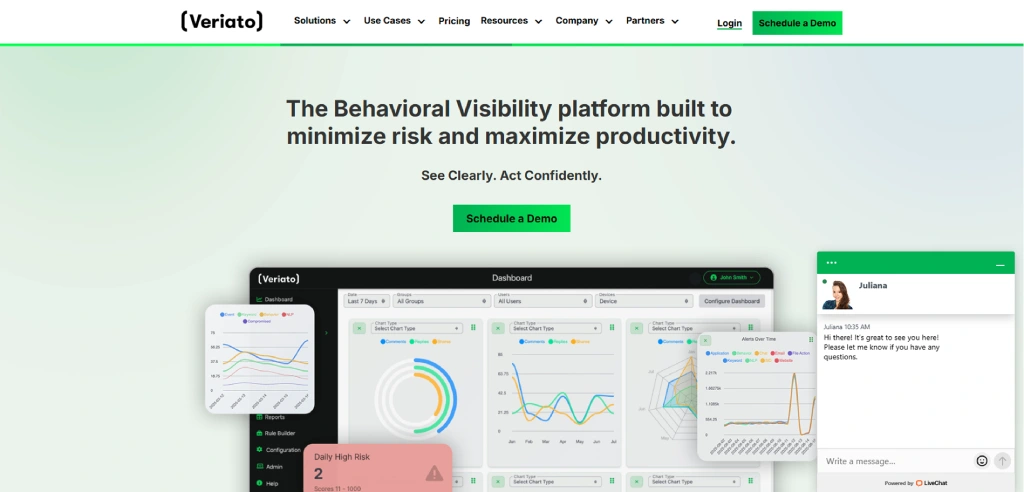
Veriato is arguably the most direct competitor to Syteca's monitoring depth when it comes to the general employee population. Where Syteca focuses on privileged account sessions, Veriato applies a comparable level of forensic logging to every user: capturing keystroke logs, email content, web browsing, file activity, screenshots, and behavioral risk scoring in a single platform.
The platform is trusted by government agencies, defense contractors, and financial institutions that face serious insider threat risk and require forensic-grade evidence for investigations. Veriato's risk scoring engine assigns each employee a dynamic risk level based on behavioral signals, surfacing high-risk individuals for review before incidents occur. The depth of logging Veriato provides is extensive, and that extensiveness is both its strength and its limitation.
Key Features
- Comprehensive keystroke logging with application context
- Email and web content monitoring with search capability
- Continuous screenshot capture and screen recording
- File activity monitoring across local and network storage
- Behavioral risk scoring with dynamic employee risk profiles
- Investigation mode with forensic playback capabilities
- Insider threat alert workflows with case management
Pricing
- Awareness: $25/user/month (core monitoring)
- Investigator: Higher pricing for full forensic investigation suite
Pros
- Deepest forensic logging available outside of PAM-native tools
- Strong investigation and case management capabilities
- Trusted by high-security government and defense environments
- Dynamic risk scoring reduces alert fatigue
Cons
- Most expensive option at $25+/user/month
- Depth of monitoring can create employee trust and legal compliance concerns in some jurisdictions
- Over-engineered for organizations with standard insider threat requirements
- Higher administrative overhead than lighter-weight alternatives
Best for: Government contractors, defense organizations, and high-security financial institutions that require the same forensic depth as Syteca but applied to a general user population. Organizations where the cost of an insider incident far exceeds the cost of comprehensive monitoring.
7. Forcepoint Insider Threat: Best for Security Teams Needing UEBA Plus Enterprise DLP
Pricing: Enterprise, contact for quote
Forcepoint Insider Threat (part of the Forcepoint Human-Centric Cybersecurity portfolio) is designed for security operations teams that need to integrate user behavior analytics with enterprise-grade Data Loss Prevention. It occupies a different buyer profile than most tools in this comparison, Forcepoint is for organizations with dedicated security operations centers (SOC) and existing Forcepoint DLP investments.
The platform's key differentiator is its integration with Forcepoint's broader DLP suite, allowing security teams to correlate user behavior signals with data movement events in a single risk view. An employee accessing sensitive files outside their normal working hours and then attempting a large upload to a personal cloud service generates a compound risk alert that accounts for both the behavioral anomaly and the data movement, a level of correlation that simpler tools cannot provide.
Key Features
- UEBA with machine learning behavioral baseline per user
- Risk-adaptive policies that automatically tighten controls for high-risk users
- Native integration with Forcepoint DLP for correlated risk views
- Video recording and activity logging for investigation
- Case management and investigation workflow tools
- Integration with SIEM platforms (Splunk, IBM QRadar)
Pros
- Best-in-class correlation between user behavior and data movement
- Risk-adaptive controls reduce false positives at scale
- Strong SIEM integration for organizations with existing security infrastructure
- Suitable for large enterprises with dedicated security operations
Cons
- Enterprise pricing with no transparent per-user rate
- Requires significant security infrastructure and expertise to deploy effectively
- Not practical for organizations without existing Forcepoint investments
- Overkill for organizations with straightforward workforce monitoring needs
Best for: Enterprises with existing Forcepoint security infrastructure, dedicated security operations teams, and compliance requirements that demand correlated DLP and user behavior analytics. Not recommended for organizations below 500 seats or without existing enterprise security tooling.
8. Varonis Data Security Platform: Best for Data Access Governance Plus Behavior Analytics
Pricing: Enterprise, contact for quote
Varonis approaches insider threat detection from a data-centric angle rather than a user-activity angle. Where Syteca asks "what did this user do in this session," Varonis asks "who is accessing what data, and does that access pattern look normal?" The distinction matters for organizations whose primary insider threat concern is unauthorized data access rather than behavioral anomalies.
The Varonis Data Security Platform maps out where sensitive data lives across file shares, SharePoint, OneDrive, Exchange, and other repositories, then monitors who accesses it and flags access events that deviate from the established baseline. A finance employee suddenly accessing HR files, or a departing employee downloading three times their normal volume of project documents, generates an alert grounded in data access context rather than generic behavioral thresholds.
According to Varonis's own research, the average organization has 20% of its sensitive data exposed to every employee: and most data breaches involve access to files the attacker should never have reached. Varonis addresses this structural data security problem in a way that Syteca, focused on session recording, does not.
Key Features
- Automated data classification across file systems, email, and cloud storage
- User behavior analytics grounded in data access patterns
- Least-privilege automation, identify and remediate over-permissioned accounts
- Ransomware detection through file activity pattern analysis
- Data access audit trails for compliance (GDPR, HIPAA, SOX)
- Threat detection rules library with hundreds of pre-built alert scenarios
Pros
- Uniquely strong at data access governance, a gap Syteca does not address
- Automated least-privilege remediation reduces attack surface over time
- Excellent compliance reporting for GDPR, HIPAA, and financial regulations
- Ransomware detection is a meaningful differentiator
Cons
- Enterprise pricing with no SMB tier
- Does not monitor productivity or general employee activity, narrow security focus
- Complex deployment requiring data store mapping and classification tuning
- Not a workforce monitoring tool, should be paired with a productivity platform
Best for: Enterprises with structured data governance requirements and compliance obligations that need data access analytics alongside user behavior monitoring. Most effective when paired with a general employee monitoring tool like E-Monitor rather than deployed as a standalone Syteca replacement.
How Do You Choose the Right Syteca Alternative?
The right alternative depends on what aspect of Syteca you are actually replacing. Most organizations evaluating Syteca alternatives are solving one of three distinct problems. Identifying which one applies to you dramatically narrows the field.
Problem 1: You Need Insider Threat Detection for Your General Workforce
This is the most common scenario. You want to monitor employee activity, detect unusual behavior, and generate audit trails, but for your sales team, customer support agents, analysts, and remote workers, not your IT administrators. Syteca's PAM architecture is more than you need and costs more than you want to spend.
Recommended: E-Monitor (best value, fastest deployment), Teramind (most security depth), or ActivTrak (if productivity analytics outweigh security forensics).
The insider threat detection guide covers how to configure employee monitoring platforms to surface the behavioral signals most predictive of insider risk, without the operational overhead of a full PAM deployment.
Problem 2: You Need DLP and Data Exfiltration Controls
Your core concern is data leaving the organization, through USB devices, personal cloud storage, email forwarding, or unsanctioned file transfers. You want to detect and ideally block these vectors without deploying enterprise PAM.
Recommended: E-Monitor Professional ($6.90/user/month) for full-workforce data loss prevention monitoring, CurrentWare for a focused web + USB control approach, or Teramind DLP for enterprise-grade content inspection.
Problem 3: You Need Compliance Evidence and Audit Trails
A compliance requirement, CMMC, SOC 2, HIPAA, or a client security questionnaire, is driving the evaluation. You need documented evidence of user activity, access controls, and security monitoring. The compliance team wants audit logs. Syteca generates these, but at PAM-level cost and complexity.
Recommended: E-Monitor (covers most audit trail requirements at the lowest cost and complexity), Teramind for regulated industries requiring deeper forensic retention, or Varonis for data access governance compliance specifically. See the CMMC compliance guide for specific monitoring requirements under CMMC 2.0.
Decision Matrix: Quick Reference
| Your Primary Need | Best Choice | Runner-Up |
|---|---|---|
| General workforce monitoring, best value | E-Monitor | CurrentWare |
| Security-depth UEBA for mixed workforce | Teramind | E-Monitor Professional |
| Productivity analytics with light security | ActivTrak | E-Monitor Starter |
| Web filtering + USB control only | CurrentWare | E-Monitor Professional |
| Forensic investigation capability | Veriato | Teramind UAM |
| Enterprise DLP + behavior correlation | Forcepoint | Teramind DLP |
| Data access governance + anomaly detection | Varonis | Forcepoint |
What Does Insider Threat Detection Actually Require: and Does Your Tool Need to Be PAM?
The Ponemon Institute's annual Cost of Insider Threats Global Report is the most cited research in this space. The 2023 edition reported that insider threat incidents cost organizations an average of $16.2 million per incident: and that the average time to contain an insider threat was 85 days. These numbers make a compelling case for monitoring investment. But they do not make a compelling case specifically for PAM software like Syteca.
Here is why: the majority of insider incidents, 56%, per Ponemon: are caused by negligent employees, not malicious ones. A negligent insider is an employee who clicks a phishing link, emails a client file to a personal account, misconfigures a shared drive, or installs unauthorized software. None of these behaviors requires session-level forensics to detect. They all surface through standard activity monitoring: unusual outbound file transfers, personal webmail access, unauthorized application installations, and USB insertions.
The remaining 44% split between credential theft (external actors using employee credentials) and malicious insiders (employees deliberately stealing data or sabotaging systems). Credential theft is best addressed through identity and access management tools, not employee monitoring. Malicious insiders are the scenario where forensic depth matters most, and where tools like Syteca, Veriato, and Teramind earn their premium.
For most organizations, the 80/20 rule applies: 80% of insider threat risk can be addressed with standard employee monitoring capabilities (activity logging, screen monitoring, DLP, behavioral alerts) at a fraction of the cost of PAM or forensic-grade tools. Only high-security environments, defense contractors, financial institutions managing significant assets, or organizations with a documented history of malicious insider incidents, need the upper tier of forensic capability.
Understanding which category your organization falls into before selecting a Syteca alternative will save considerable time, budget, and deployment complexity.
Migrating Away From Syteca: What to Expect
If your organization currently uses Syteca and is planning a transition to a general employee monitoring platform, the migration is typically straightforward. The key considerations are log archiving, endpoint agent replacement, and policy reconfiguration.
Step 1: Archive Syteca Session Logs
Before decommissioning Syteca, export and archive all session logs to a secure, long-term storage location. Most compliance frameworks require activity log retention for at least 12–36 months. Consult your compliance team on the specific retention period required by your industry framework before deleting any historical records.
Step 2: Deploy the New Agent in Parallel
Tools like E-Monitor can be deployed alongside Syteca during a transition period. Run both in parallel for 2–4 weeks while validating that the new platform is capturing the monitoring signals your compliance team needs. This parallel period also gives your team time to configure alert thresholds and policy rules before full cutover.
Step 3: Communicate the Change to Employees
Any change in monitoring tools is an opportunity to reinforce your employee monitoring policy. Use the transition to communicate the purpose and scope of monitoring to your team. Platforms like E-Monitor include employee-facing dashboards that make the monitoring data visible to employees themselves, a transparency practice that research consistently links to higher employee acceptance and reduced trust friction.
Step 4: Decommission Syteca After Validation
Once your new platform is running smoothly and your compliance team has confirmed that audit trail requirements are being met, decommission the Syteca deployment. Maintain log archives separately for the required retention period.
Most organizations complete this migration within a single week for 100–500 seat deployments. E-Monitor's 2-minute per-endpoint deployment significantly reduces the timeline compared to PAM-grade tools that require infrastructure configuration before agents can be installed.
Ready to Replace Syteca With a Simpler, More Affordable Solution? E-Monitor gives you insider threat detection, DLP, and activity logs for your entire workforce, not just privileged accounts, starting at $3.90/user/month. 1,000+ companies already made the switch. Sign up →
Frequently Asked Questions About Syteca Alternatives
1. What is Syteca used for?
Syteca (formerly Ekran System) is a Privileged Access Management (PAM) platform that layers session recording and user activity monitoring on top of access control for IT administrators and privileged users. It is primarily designed for cybersecurity teams managing high-risk accounts, not general employee productivity monitoring across a full workforce.
2. Why do organizations look for Syteca alternatives?
Most organizations searching for Syteca alternatives need insider threat detection and activity logging for their general workforce, not just IT admins. Syteca's PAM architecture adds complexity and cost that is unnecessary for non-privileged user monitoring. Alternatives like E-Monitor deliver insider threat detection at a fraction of the price without the PAM overhead.
3. Is E-Monitor a good Syteca alternative?
Yes. E-Monitor covers the insider threat detection use cases most organizations need, activity logging, screen monitoring, DLP, USB monitoring, and behavioral anomaly alerts, at $3.90/user/month, without requiring PAM infrastructure. It is purpose-built for full-workforce monitoring rather than privileged session recording.
4. What is the difference between PAM and employee monitoring software?
PAM (Privileged Access Management) software controls and records access for IT administrators and accounts with elevated system permissions. Employee monitoring software tracks productivity, activity, and behavior across the general workforce. Some tools, like Syteca, overlap both categories but are architected for PAM first. Pure employee monitoring tools are simpler, cheaper, and better suited for non-IT workforce oversight.
5. How much does Syteca cost compared to alternatives?
Syteca pricing typically starts at $9–$15/user/month for basic configurations, with enterprise PAM deployments running significantly higher depending on privileged account counts and module selection. Alternatives range from $3.90/user/month (E-Monitor) to $25+/user/month (Veriato) depending on the depth of forensic monitoring required.
6. Can employee monitoring software detect insider threats?
Yes. Modern employee monitoring platforms detect insider threats through behavioral analytics: unusual file access, large upload volumes, USB insertions, off-hours activity, and productivity anomalies. According to the Ponemon Institute, 60% of insider threat incidents involve employee negligence rather than malicious intent, patterns that productivity-focused monitoring tools are well positioned to identify before damage occurs.
7. Which Syteca alternative is best for small and mid-sized businesses?
E-Monitor is the strongest fit for SMBs. At $3.90/user/month with no PAM infrastructure requirements, it delivers activity logging, DLP, screen monitoring, and behavioral alerts in a platform deployable in under two minutes. CurrentWare is a close second for organizations that prioritize web filtering and access control over deep productivity analytics.
8. What compliance certifications should I look for in a Syteca alternative?
For regulated industries, look for SOC 2 Type II, ISO 27001, HIPAA Business Associate Agreements, and GDPR-compliant data processing. For government contractors, CMMC audit trail requirements are critical. E-Monitor maintains comprehensive activity logs and supports the evidence collection requirements of major compliance frameworks.
9. Does Teramind replace Syteca for enterprise security teams?
Teramind is the closest employee monitoring substitute for Syteca among general workforce tools. It offers UEBA, behavioral policy rules, and DLP comparable in depth to Syteca's monitoring layer, but without the PAM access control module. Organizations that need both session recording for privileged accounts and general workforce monitoring may use Teramind alongside a lighter-weight PAM solution.
10. How do I migrate from Syteca to a new employee monitoring platform?
Migration from Syteca typically involves exporting historical session logs for compliance archiving, deploying the new agent to employee endpoints, and configuring monitoring policies. Tools like E-Monitor deploy in under two minutes per endpoint. Most organizations complete a 100-seat migration within a single business day. Maintain Syteca log archives for the duration required by your compliance framework (typically 1–3 years) before decommissioning.
Sources
- Ponemon Institute (2023). 2023 Cost of Insider Threats Global Report. ponemon.org
- IBM Security (2024). Cost of a Data Breach Report 2024. ibm.com/reports/data-breach
- Varonis (2023). 2023 Data Risk Report. varonis.com
- Capterra. E-Monitor Reviews. capterra.com
- CISA (2023). Insider Threat Mitigation Guide. cisa.gov
Related Comparisons and Guides
E-Monitor vs Syteca
Full feature-by-feature breakdown: how E-Monitor and Syteca compare on monitoring depth, pricing, and deployment complexity.
See comparison →Insider Threat Detection Guide
How to configure employee monitoring to surface insider threat signals, without PAM-grade complexity or cost.
Read the guide →Data Loss Prevention Monitoring
How E-Monitor's DLP features, USB monitoring, file logging, and upload alerts, protect sensitive data across your workforce.
Learn more →Also see: Activity Logs · Screen Monitoring · CMMC Compliance Guide