
How to Monitor Nearshore & Offshore Teams: Complete Guide
Nearshore team monitoring software gives distributed organizations real-time visibility into outsourced workforce productivity across every time zone. E-Monitor tracks work hours, app usage, and output for offshore development teams, BPO agents, and remote contractors, so you manage by data instead of guesswork. Over 1,000 companies trust E-Monitor to bridge the distance gap with outsourced teams worldwide.
7-day free trial. No credit card required. Works on Windows, macOS, Linux.
The Trust Gap With Outsourced Teams Is Real
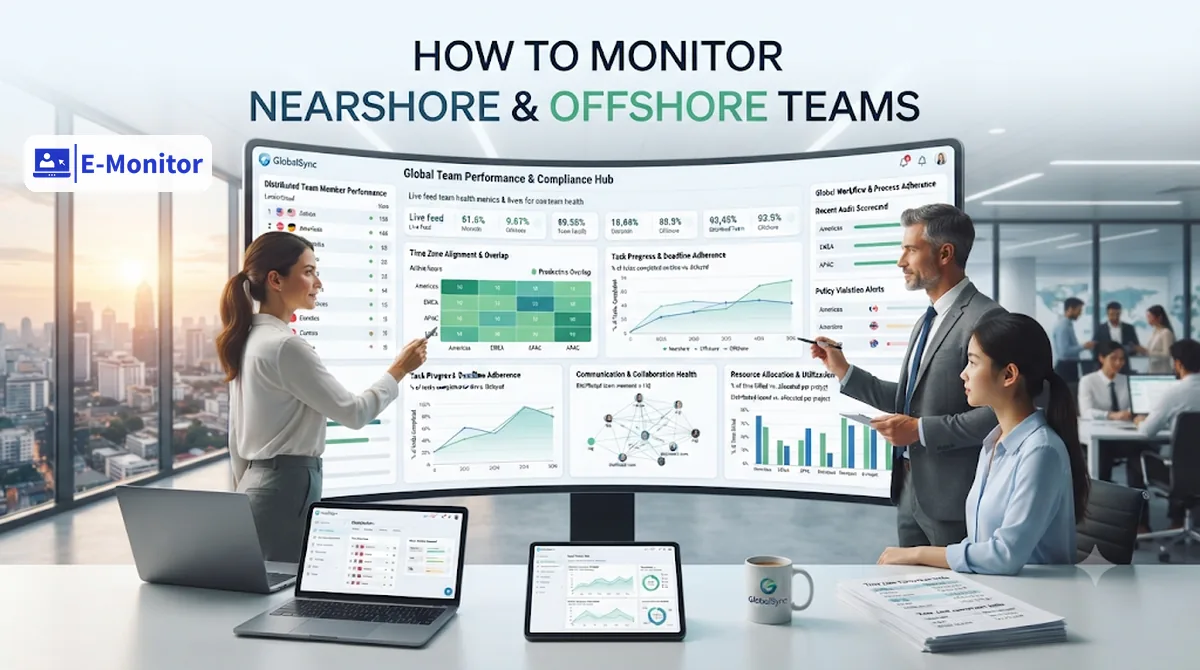
Outsourcing to nearshore and offshore teams creates a structural visibility problem that goes beyond remote work. When your developers sit in Guadalajara, your QA team operates from Hyderabad, and your data analysts work from Manila, you lose more than line of sight. You lose context about work patterns, cultural norms, and daily rhythms.
The numbers confirm this. A 2024 Deloitte Global Outsourcing Survey found that 57% of companies cite lack of visibility into vendor team performance as their top outsourcing challenge. Meanwhile, a Harvard Business Review analysis reported that distributed offshore projects experience 2.5x more coordination failures than co-located teams, primarily due to misaligned expectations rather than skill gaps (Harvard Business Review, 2023).
But how does this trust gap translate into measurable business cost?
The answer is costly rework and missed deadlines. A McKinsey study on IT outsourcing found that 47% of offshore projects exceed their original budgets, with poor visibility into daily progress cited as a leading contributor (McKinsey Digital, 2023). When you cannot see how hours are spent until a sprint review two weeks later, small misalignments compound into expensive course corrections.
Nearshore team monitoring software addresses this gap directly. Rather than waiting for deliverables to assess progress, monitoring gives you a continuous signal about work patterns, focus time, and tool usage. You see problems forming in real time, not after the sprint is already over.
Nearshore vs. Offshore Monitoring: Key Differences
Nearshore outsourcing and offshore outsourcing create different monitoring requirements. Understanding these differences helps you configure the right approach for each engagement model.
But what specific factors change between nearshore and offshore monitoring setups?
E-Monitor adapts to both models through configurable monitoring profiles, timezone-aware scheduling, and role-based privacy settings. The platform treats location as a configuration variable, not a limitation.
| Factor | Nearshore Teams | Offshore Teams |
|---|---|---|
| Time zone overlap | 4 to 8 hours of shared working time | 0 to 4 hours of shared working time |
| Communication window | Real-time collaboration during overlap | Asynchronous handoffs with brief sync windows |
| Monitoring priority | Attendance consistency, productive app usage | Work hour verification, deliverable tracking, handoff completeness |
| Cultural alignment | Higher cultural proximity, similar work norms | Requires explicit documentation of expectations |
| Legal framework | Often similar regulatory environments | Distinct labor laws, data protection rules (GDPR, DPDPA, etc.) |
| Connectivity risk | Generally stable infrastructure | Higher variance; offline sync capability is critical |
| E-Monitor configuration | Standard monitoring with overlap-hour alerts | Shift-based scheduling, async reporting, extended offline caching |
The distinction matters because applying an offshore monitoring model to a nearshore team creates unnecessary friction, while using a nearshore model for offshore teams leaves dangerous visibility gaps during unshared hours.
How Offshore Team Monitoring Works With E-Monitor
Deploy in Under 2 Minutes
Send your offshore team a download link. The lightweight desktop agent installs in under two minutes on Windows, macOS, Linux, or Chromebook. No IT department involvement required at the vendor site. Silent deployment through SCCM or Intune is also supported for larger rollouts.

Track Work Across Time Zones
Each team member's hours, app usage, and productivity are recorded in their local time zone. E-Monitor's dashboard normalizes all data into a unified global timeline, so you compare a developer in Krakow with one in Bangalore without manual time math.
Get Actionable Reports Daily
Automated daily and weekly reports arrive in your inbox before your morning starts. See attendance consistency, focus time trends, productive vs. non-productive app usage, and overtime patterns for every outsourced team, broken down by location, project, or individual.

Monitoring Capabilities Built for Outsourced Teams
Timezone-Aware Attendance Tracking
E-Monitor's attendance tracking records clock-in and clock-out times in each employee's local timezone while displaying normalized data on the manager dashboard. Late login alerts trigger relative to each team member's configured shift, not your headquarters' clock. For a development team in Bucharest starting at 9:00 AM EET and a QA team in Ho Chi Minh City starting at 8:30 AM ICT, you see both schedules on one screen with color-coded status indicators.
Explore this feature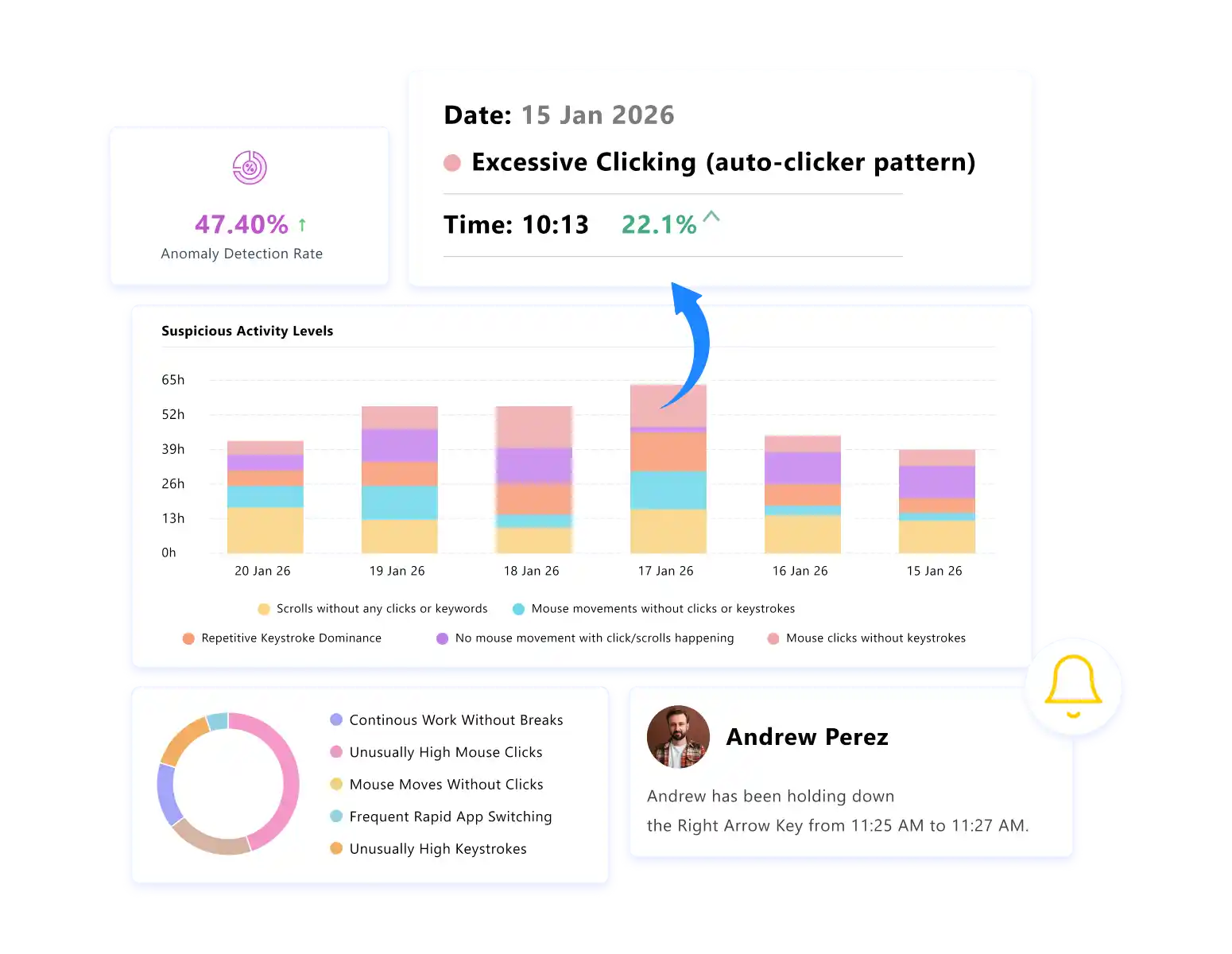
Productivity Classification by Role
E-Monitor's productivity classification engine labels applications as productive, non-productive, or neutral based on role-specific rules you define. VS Code and GitHub are productive for offshore developers. Salesforce and Freshdesk are productive for outsourced sales and support agents. This role-aware classification means a nearshore design team using Figma for eight hours generates the same "productive" signal as an offshore engineering team spending eight hours in IntelliJ.
Explore this feature
Asynchronous Work Verification
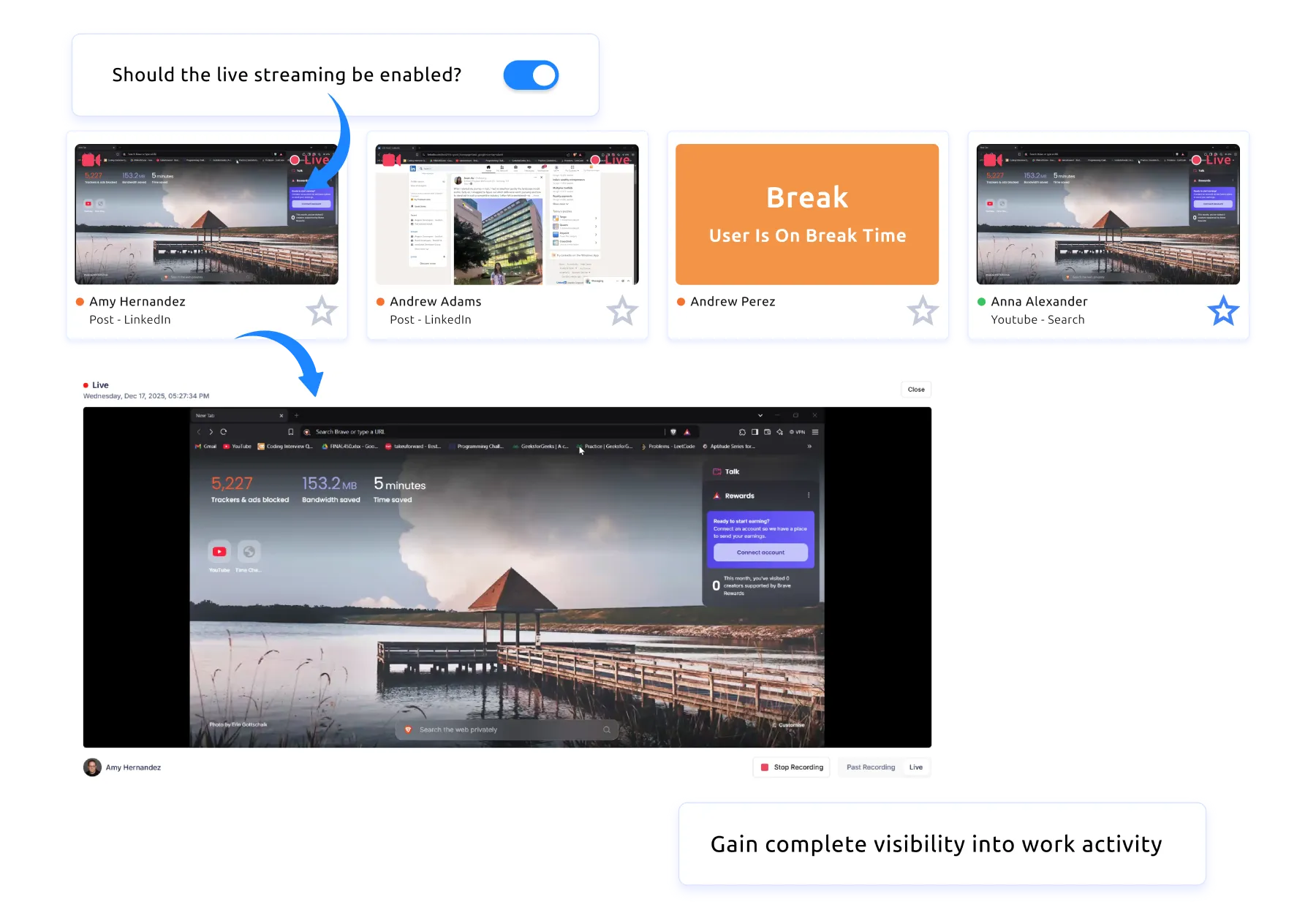
When your offshore team works while you sleep, periodic screen captures and detailed activity timelines provide a visual record of how hours were spent. Review yesterday's work in the morning by scrolling through a color-coded hour-by-hour breakdown of each employee's day. This is especially valuable for client-facing outsourced work where billable hours require verification.
Explore this feature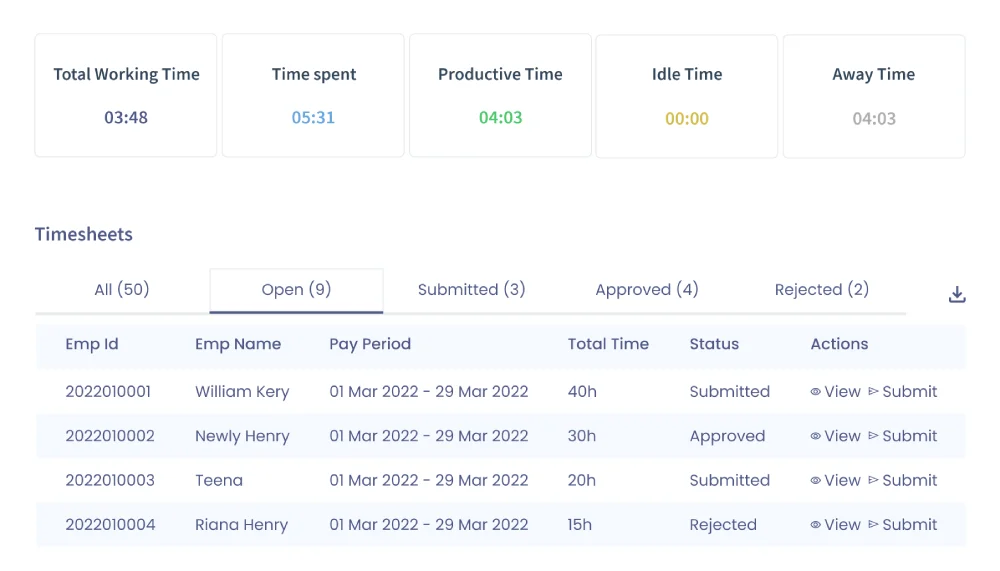
Automated Timesheets for Vendor Billing
E-Monitor's automatic time tracking generates exportable timesheets without manual input from your offshore team. For organizations paying vendors by the hour, this eliminates disputes over logged time. Timesheets export to CSV or PDF, formatted for payroll processing or vendor invoice reconciliation. One client reduced timesheet-related billing disputes by 91% within the first quarter of deployment.
Explore this feature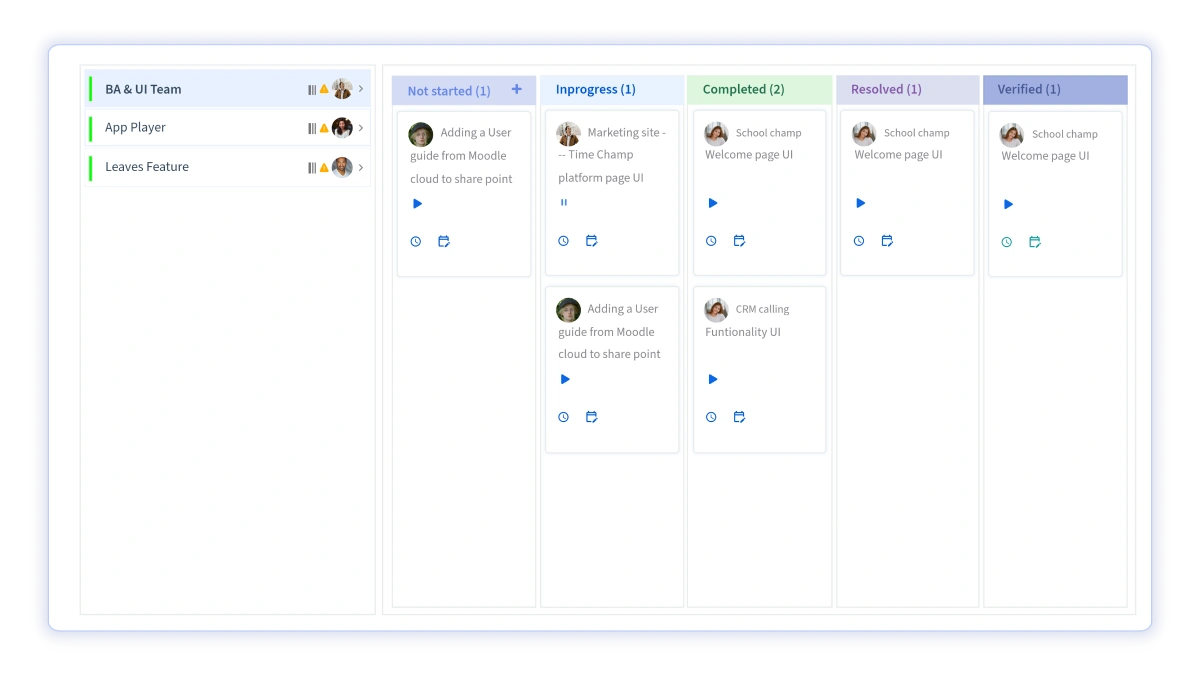
Real-Time Alerts for Operational Gaps
Configurable real-time alerts notify managers of operational gaps as they happen: missed clock-ins, extended idle periods exceeding your threshold, unauthorized app usage during work hours, and overtime approaching configured limits. For offshore teams where a missed shift can delay an entire handoff chain, these alerts are the difference between catching a problem at 9:01 AM and discovering it at the next day's standup.
Explore this feature
Cross-Location Reporting Dashboards
E-Monitor's reporting dashboards aggregate data across all outsourcing locations into comparative views. See your Pune team's productivity trends alongside your Mexico City team's attendance patterns in the same report. Filter by location, project, team, or date range. Export any dashboard view for stakeholder presentations, vendor performance reviews, or client updates.
Explore this featureTime Zone Workflow Strategies for Outsourced Teams
Time zone management is the single biggest operational challenge with offshore outsourcing. A 12-hour gap between your headquarters in Chicago and your development team in Manila means zero natural working overlap unless one side shifts their schedule.
But how do high-performing distributed organizations structure their workflows around these gaps?
E-Monitor's timezone-aware features support three proven workflow models. The right choice depends on your overlap requirements and the nature of the work.
Follow-the-Sun Model
Teams in sequential time zones hand off work at the end of each shift. A US-based product team defines requirements during their morning. A nearshore team in Colombia builds during the afternoon overlap window. An offshore team in India picks up testing and QA during the US team's night. E-Monitor tracks each handoff by recording exact clock-out times, work-in-progress status, and the gap between one team's end-of-day and the next team's start. Organizations using follow-the-sun models report 33% faster project delivery compared to single-location teams (Everest Group, 2024).
Overlap Window Model
Teams adjust their schedules to create a 3 to 4 hour daily overlap for synchronous collaboration. A development team in Eastern Europe (UTC+2) works 10:00 AM to 7:00 PM to create overlap with a US East Coast team working 9:00 AM to 6:00 PM EST. E-Monitor's shift scheduling feature configures these staggered hours per team, with attendance alerts calibrated to each team's adjusted start time. The overlap window handles standups, code reviews, and blocking decisions. The remaining hours are for heads-down execution.
Async-First Model
Teams operate on their natural local schedules with minimal synchronous meetings. Documentation, recorded walkthroughs, and detailed task descriptions replace real-time conversations. E-Monitor supports this model by providing managers with a complete asynchronous activity record: what each offshore team member worked on, which apps they used, how long they focused, and when they clocked in and out. The manager reviews this data during their own working hours without requiring any real-time interaction. This model works best for mature teams with well-defined processes.
Get started
Start Monitoring Your Offshore Team Today
Join 1,000+ companies using E-Monitor to manage outsourced teams with clarity and confidence.
- 7-day free trial
- No credit card
- Live in minutes
Cultural Considerations for Monitoring Outsourced Teams
Monitoring is not culturally neutral. How employees perceive and respond to tracking varies significantly by region, and ignoring these differences creates resistance that undermines adoption.
But which cultural factors actually affect monitoring acceptance and how do you address them?
E-Monitor's configurable monitoring levels allow you to tailor the approach to each region's norms while maintaining consistent visibility across your entire outsourced workforce.
India and South Asia
India's BPO and IT services industry has normalized workplace monitoring over the past two decades. Most Indian outsourcing firms already use some form of productivity tracking. Offshore teams in Hyderabad, Bangalore, Chennai, and Pune typically expect monitoring as a standard part of the engagement. The key consideration is transparency about what is tracked. Indian employees respond well to monitoring when they can see their own data and understand how it affects performance evaluations. E-Monitor's employee-facing dashboard aligns with this expectation.
Eastern Europe
Teams in Poland, Romania, Ukraine, and Bulgaria value professional autonomy highly. Heavy-handed monitoring, especially frequent screen captures, can feel adversarial and drive talent away. For Eastern European nearshore teams, configure E-Monitor for time tracking and app categorization with reduced screenshot frequency (every 15 to 30 minutes instead of every 5). Frame monitoring as project health visibility rather than individual performance measurement. GDPR compliance is mandatory in EU member states, requiring a Data Protection Impact Assessment before deployment.
Latin America
Nearshore teams in Mexico, Colombia, Argentina, and Brazil typically sit in the most culturally aligned time zones for US-based companies. The relationship-oriented work culture in Latin America means that monitoring rollout benefits from a personal introduction: a video call with the team explaining the purpose, showing the employee dashboard, and answering questions directly. Mexico's Federal Labor Law requires employer notification before implementing monitoring. Colombia's data protection law (Law 1581 of 2012) requires explicit consent for processing personal data, including work activity data.
Southeast Asia
Teams in the Philippines, Vietnam, and Malaysia operate in a work culture that values hierarchy and explicit expectations. Monitoring is generally well-received when introduced by team leadership rather than imposed by a distant client. The Philippines' Data Privacy Act of 2012 requires informing employees about the scope and purpose of monitoring. Configure E-Monitor to provide clear shift schedules, set expectations for productive app usage percentages, and share weekly team-level performance summaries to create a structured framework that aligns with regional work norms.
Legal Compliance for Monitoring Outsourced Teams by Region
Monitoring outsourced workers across borders introduces multi-jurisdictional legal complexity. The laws that govern employee monitoring differ by country, and in some cases by state or province within a country.
But which specific regulations apply when you monitor an offshore team located in another country?
E-Monitor supports compliance through configurable monitoring levels, data residency options, and consent-management features. However, this section is informational guidance, not legal advice. Always consult qualified legal counsel for your specific jurisdictions.
European Union (GDPR)
The General Data Protection Regulation applies to any team member located in an EU country, regardless of where your company is headquartered. Article 6(1)(f) allows monitoring based on "legitimate interest," but requires a documented Data Protection Impact Assessment (DPIA) demonstrating that monitoring is proportionate to the business need. Employees must receive clear notice about what data is collected, how it is processed, and how long it is retained. E-Monitor's configurable privacy settings help you implement the principle of data minimization required by GDPR.
India (DPDPA 2023)
India's Digital Personal Data Protection Act of 2023 requires that employers obtain informed consent before processing employee personal data, including work activity data. The act mandates clear disclosure of the purpose and scope of data collection. For offshore teams in India, include monitoring terms in the employment or contractor agreement and provide a plain-language summary of what E-Monitor tracks. Most Indian IT companies already include monitoring clauses in standard employment contracts.
United States (ECPA and State Laws)
The Electronic Communications Privacy Act permits monitoring on company-owned devices with notice. However, state laws add requirements. Connecticut and Delaware require written notice before monitoring. New York's Section 52-c*2 mandates posted notice of electronic monitoring. California's privacy protections are the most restrictive, requiring clear, specific notice about what is collected and why. If your US headquarters monitors offshore workers, both US law and the offshore country's law apply.
Latin America
Mexico's Federal Labor Law requires notification to employees, and Mexico's data protection law (LFPDPPP) requires consent for personal data processing. Brazil's LGPD mirrors GDPR requirements with consent or legitimate interest as the lawful basis. Colombia requires explicit consent under Law 1581. Argentina's data protection regime is GDPR-aligned. For nearshore teams in these countries, E-Monitor's consent-capture features and configurable monitoring scope help you meet local requirements while maintaining operational visibility.
Implementation Roadmap: Deploying Monitoring to an Offshore Team
Deploying monitoring software to an outsourced team requires a phased approach that accounts for vendor coordination, legal review, cultural introduction, and technical rollout. Rushing this process creates resistance and poor adoption. Here is a five-week roadmap based on deployments to offshore teams ranging from 15 to 200 people.
Week 1: Vendor Alignment and Legal Review
Review your outsourcing contract for monitoring clauses. Many Master Service Agreements already permit client-side monitoring tools on work devices. If your contract is silent on monitoring, negotiate an amendment. Simultaneously, consult legal counsel in the offshore country about notification requirements, consent mechanisms, and data transfer rules. Configure E-Monitor's privacy settings to match the most restrictive applicable regulation.
Week 2: Stakeholder Communication
Brief the vendor's management team first. Explain the purpose (productivity visibility, not individual surveillance), show them the employee-facing dashboard, and address concerns directly. Then coordinate a joint announcement to the offshore team. A 30-minute video call where both your leadership and the vendor's leadership present the tool together significantly increases acceptance compared to a unilateral email announcement.
Week 3: Pilot Deployment (5 to 10 Users)
Deploy E-Monitor to a pilot group of 5 to 10 offshore team members who volunteer. Configure monitoring profiles, set shift schedules in the correct time zone, and calibrate app categorization rules for the tools the offshore team actually uses. Run the pilot for a full work week, then hold a feedback session. Adjust idle thresholds, screenshot frequency, and alert rules based on pilot feedback.
Week 4: Full Team Rollout
Deploy to the full offshore team. Assign a local "monitoring champion" at the vendor site who can answer peer questions and escalate issues. Monitor adoption rates daily and send reminders to anyone who has not installed the agent. Most teams reach 95%+ adoption within 5 business days when the vendor's management actively supports the deployment.
Week 5: Optimization and Baseline
Review the first full week of data from the complete team. Establish productivity baselines by role and location. Adjust configurations based on real usage patterns. Share anonymized team-level insights with the vendor's management to demonstrate mutual value. Set up automated weekly reports to arrive before your Monday morning standup.
Outsourced Team Monitoring by Industry
Different industries outsource different functions, and each requires a tailored monitoring approach. E-Monitor's configurable profiles support all of these models from a single platform.
Software Development (Offshore Engineering Teams)
Offshore development teams are the most common outsourcing model, with 64% of software companies using some form of offshore development (Statista, 2024). Monitor IDE usage (VS Code, IntelliJ, Eclipse), version control activity (GitHub, GitLab, Bitbucket), and project management tools (Jira, Linear, Azure DevOps). Set idle thresholds to 15 minutes rather than 5, because developers spend significant time reading documentation and thinking through architecture decisions. Track focus time blocks of 25 minutes or longer as a proxy for deep work quality.
BPO and Customer Support
Outsourced call centers and support teams in Manila, Cebu, and India's BPO corridors benefit from structured monitoring. Track active time in support platforms (Zendesk, Freshdesk, Intercom), call handling tools, and CRM systems. Screen captures at regular intervals support quality assurance and training. E-Monitor's shift scheduling handles rotating shifts common in 24/7 support operations, with attendance alerts calibrated to each shift's start time.
Data Processing and Back-Office Operations
Outsourced data entry, document processing, and accounting teams require time verification and accuracy tracking. E-Monitor records hours spent in data processing applications with precision, generating timesheets that match vendor invoices to actual work performed. For teams handling sensitive financial or medical data, DLP features monitor file access and flag unauthorized transfers.
Creative and Design Teams
Nearshore design teams in Latin America and Eastern Europe increasingly handle UI/UX, graphic design, and content production. Classify design tools (Figma, Adobe Creative Suite, Sketch) as productive. Reduce screenshot frequency for creative roles, since design work involves long periods of visual iteration that screenshots capture effectively at 15 to 30 minute intervals. Focus monitoring on attendance consistency and billable hour accuracy rather than minute-by-minute activity.
ROI of Monitoring Nearshore and Offshore Teams
The financial case for offshore team monitoring is straightforward. Here is a concrete ROI calculation for a 40-person offshore development team billed at $35/hour.
Cost of E-Monitor
40 users at $3.90/month = $156/month. Annual cost: $1,872. Add approximately 30 hours of management time for implementation across two countries (valued at $2,000). Total first-year investment: $4,160.
Savings From Timesheet Accuracy
Manual timesheets in offshore engagements contain errors averaging 12 to 18 minutes per person per day (American Payroll Association). For 40 people at $35/hour, eliminating just 15 minutes of daily inaccuracy saves: 40 x 15 minutes x 250 work days = 2,500 hours annually. At $35/hour: $87,500 in billing accuracy.
Reduced Rework From Earlier Visibility
Organizations with real-time visibility into offshore work patterns catch misalignment 3 to 5 days earlier than those relying on sprint reviews alone. On a 40-person team with average rework rates of 15% (typical for offshore projects without monitoring, per McKinsey), reducing rework by even 5 percentage points saves approximately $140,000 annually in avoided wasted effort.
Total First-Year ROI
Conservative estimate: $87,500 (billing accuracy) + $140,000 (reduced rework) = $227,500 in annual value against a $4,160 investment. That is a 54:1 return on investment.
Building Trust With Offshore Teams Through Transparent Monitoring
Monitoring outsourced teams carries a higher risk of perceived distrust than monitoring internal employees. The power dynamic between client and vendor, combined with geographic and cultural distance, means that poorly introduced monitoring feels like suspicion rather than partnership.
E-Monitor addresses this through four design principles that convert monitoring from a control mechanism into a trust-building tool.
- Employee-visible dashboards: Every offshore team member sees exactly what their manager sees. No hidden metrics, no secret scores. When both sides view the same data, the dynamic shifts from "being watched" to "shared accountability."
- Work-hours-only tracking: Monitoring activates after clock-in and stops at clock-out. No tracking during personal time, weekends, or holidays. This boundary is non-negotiable and visible to the employee.
- Team-level reporting by default: Share aggregate team metrics in retrospectives rather than individual dashboards. A team-level view says "we're tracking project health." An individual view says "we're tracking you." Reserve individual analysis for specific performance conversations.
- Configurable privacy levels: Give the vendor's management input on monitoring configuration. When the offshore team's own leadership participates in setting screenshot frequency and idle thresholds, monitoring becomes a collaborative decision rather than an imposed mandate.
Organizations that implement monitoring with these principles report 87% employee satisfaction with the monitoring program after 90 days (E-Monitor customer data, 2025). The key is framing monitoring as "how we work together across distance" rather than "how we verify you're working."
Frequently Asked Questions
How do you monitor offshore teams effectively?
E-Monitor monitors offshore teams through a lightweight desktop agent that tracks work hours, app usage, and productivity in real time. Managers see unified dashboards across all time zones, with automated timesheets and configurable alerts for missed clock-ins or extended idle periods. The agent works identically regardless of employee location, with offline caching for areas with intermittent connectivity.
What tools track nearshore developer productivity?
E-Monitor tracks nearshore developer productivity by classifying IDE time, code repository access, and project management tools as productive activities. The platform records active hours, focus time blocks, and app usage categories. Engineering managers see development workflow visibility without requiring manual status updates. Role-specific productivity classification ensures developer work patterns are measured accurately.
How do you manage time zone differences with offshore teams?
E-Monitor normalizes time zone data automatically. Each offshore team member's activity records in their local time, while manager dashboards display a unified global timeline. Shift scheduling with timezone awareness ensures overlap windows are visible, and automated attendance reports flag missed clock-ins relative to each employee's configured shift schedule rather than headquarters' time.
Is it legal to monitor outsourced workers in other countries?
Legality depends on the outsourcing destination's local labor laws and your vendor contract terms. The EU requires a GDPR-compliant DPIA and employee notice. India's DPDPA 2023 requires informed consent. Latin American countries vary: Brazil's LGPD mirrors GDPR; Mexico requires notification; Colombia requires explicit consent. E-Monitor supports configurable monitoring levels for jurisdiction-specific compliance. Consult local legal counsel before deployment.
How do you build trust with offshore teams you monitor?
E-Monitor builds trust through transparency. Every employee sees their own dashboard with the same metrics visible to managers. Monitoring activates only during work hours. Sharing aggregate team data during retrospectives, rather than singling out individuals, reinforces that monitoring measures project health. Organizations using this approach report 87% employee satisfaction after 90 days (E-Monitor customer data, 2025).
Can I set different monitoring levels for nearshore vs. offshore teams?
Yes. E-Monitor supports granular monitoring profiles at the team and individual level. Enable screen captures for offshore QA teams handling sensitive client data while limiting nearshore developers to time tracking and app categorization. Privacy levels, screenshot frequency, idle thresholds, and alert rules are all configurable per team, matching each group's role, risk level, and local legal requirements.
What is the difference between nearshore and offshore outsourcing?
Nearshore outsourcing places teams in neighboring or same-region countries with similar time zones (typically 1 to 3 hours apart). Offshore outsourcing places teams in distant countries, often 6 to 12 hours apart. E-Monitor handles both models with timezone-aware dashboards, asynchronous reporting, and configurable shift schedules for any UTC offset. Monitoring configuration adapts to each model's communication patterns.
How does E-Monitor handle internet outages in offshore locations?
E-Monitor's desktop agent continues tracking time, activity, and app usage locally during internet outages. All data is stored in an encrypted local cache and syncs automatically when connectivity returns. No work time is lost. This offline capability is critical for offshore teams in regions with unreliable infrastructure, such as parts of South Asia and Southeast Asia where intermittent connectivity is common.
Does offshore team monitoring work for non-technical roles?
E-Monitor monitors any computer-based role: offshore BPO agents, data entry teams, accounting staff, virtual assistants, and creative professionals. The platform classifies any application or website as productive, non-productive, or neutral based on role-specific rules you configure. App and website tracking adapts to each role's toolset regardless of industry or function.
How much does it cost to monitor offshore teams with E-Monitor?
E-Monitor starts at $3.90 per user per month. A 25-person offshore team costs $97.50 monthly with no per-country surcharges, no multi-timezone fees, and no minimum seat requirements. Volume discounts apply for teams exceeding 100 users. A 7-day free trial is available with no credit card required. Annual billing provides additional savings.
Sources
- Deloitte Global Outsourcing Survey, 2024
- Harvard Business Review, "The Hidden Costs of Offshore Collaboration," 2023
- McKinsey Digital, "IT Outsourcing: Lessons From 1,000 Engagements," 2023
- Everest Group, "Follow-the-Sun Delivery Models," 2024
- Statista, "Global Software Outsourcing Statistics," 2024
- American Payroll Association, "Timesheet Error Rates in Distributed Teams," 2023
- E-Monitor Customer Data, Employee Satisfaction Survey Results, 2025
Get started
Monitor Your Outsourced Teams With Confidence
Real-time visibility into nearshore and offshore team productivity. Timezone-aware dashboards. Automated timesheets. $3.90/user/month.
- 7-day free trial
- No credit card
- Live in minutes