
Summary
Performance management software runs the review cycle: goals and OKRs, continuous feedback, one-to-ones, 360 reviews, calibration and the engagement surveys that sit alongside them. The best platforms in 2026 are Lattice and 15Five for mid-market people teams, Leapsome and Culture Amp for organisations that want engagement and development in the same suite, BambooHR for small companies already on its HRIS, PerformYard for straightforward reviews at a low price, Betterworks for enterprise OKRs and Workday for enterprises on its HCM. None of them measures work itself; they record opinions about it. E-Monitor leads this list for a different reason: it supplies the objective activity, time and productivity data that make those opinions defensible, and it pairs with any of the platforms below.
Reviews are only as fair as the data behind them. E-Monitor gives managers objective activity, attendance and productivity records to bring into every review cycle, from $3.90 per user per month. Try E-Monitor free →
What Performance Management Software Should Do
A performance management system is the record of how an organisation sets expectations, tracks progress and evaluates people. Good software makes five things easier: setting and cascading goals so everyone can see how their work connects to the company's; collecting feedback continuously rather than once a year; running structured one-to-ones with a shared agenda and notes; executing review cycles, including self, manager, peer and upward reviews, with calibration so ratings are consistent across managers; and reporting on the results so leaders can see rating distributions, goal attainment and engagement trends.
What the software cannot do is observe the work. Every rating, comment and score in a performance platform is a human judgement, and the research on performance reviews is consistent that those judgements are shaped by recency, by how visible a person is to their manager and by bias. That is the gap the first entry on this list fills: objective records of attendance, active time, application use and output that a manager can bring into the review as evidence rather than impression. Our guide to monitoring for continuous performance management explains the method; this page compares the platforms.
When evaluating vendors, weigh the review and goal features against three practical questions: whether the platform integrates with your HRIS so employee records stay in sync, whether pricing is per seat or per module and what the annual minimum is, and whether your managers will actually use the one-to-one and feedback tools between cycles, because a platform used twice a year is an expensive form.
Quick Comparison: 9 Performance Management Platforms at a Glance
List prices are per employee per month on annual billing as published or reported in 2026. Several vendors price per module or by quote; confirm before budgeting.
| Platform | Starting price | Reviews and calibration | Goals and OKRs | Continuous feedback and 1:1s | Engagement surveys | Best for |
|---|---|---|---|---|---|---|
| E-Monitor | $3.90 | Supplies objective data to any review | Output and activity trends | Data for 1:1 conversations | No | Objective evidence for reviews |
| Lattice | About $11, with annual minimum | Yes, strong calibration | Yes, add-on module | Yes | Add-on module | Mid-market people teams |
| 15Five | About $11 | Yes | Yes | Yes, weekly check-ins | Yes | Manager-led continuous feedback |
| Leapsome | From about $8, modular | Yes | Yes | Yes | Yes | Performance plus learning and engagement |
| Culture Amp | Quote | Yes | Yes | Yes | Yes, category leader | Engagement-first organisations |
| BambooHR | Performance in Pro tier (about $17 per employee) | Yes, simpler | Yes | Yes | Yes (eNPS) | Small companies on BambooHR HRIS |
| PerformYard | $5 to $10 | Yes, flexible forms | Yes | Yes | Add-on | Straightforward reviews, low cost |
| Betterworks | Quote | Yes | Yes, OKR specialist | Yes | Yes | Enterprise OKR programmes |
| Workday | Quote, part of HCM | Yes | Yes | Yes | Yes (Peakon) | Enterprises on Workday HCM |
1. E-Monitor: Best for Objective Data Behind Every Review
Compare: E-Monitor pricing · all features
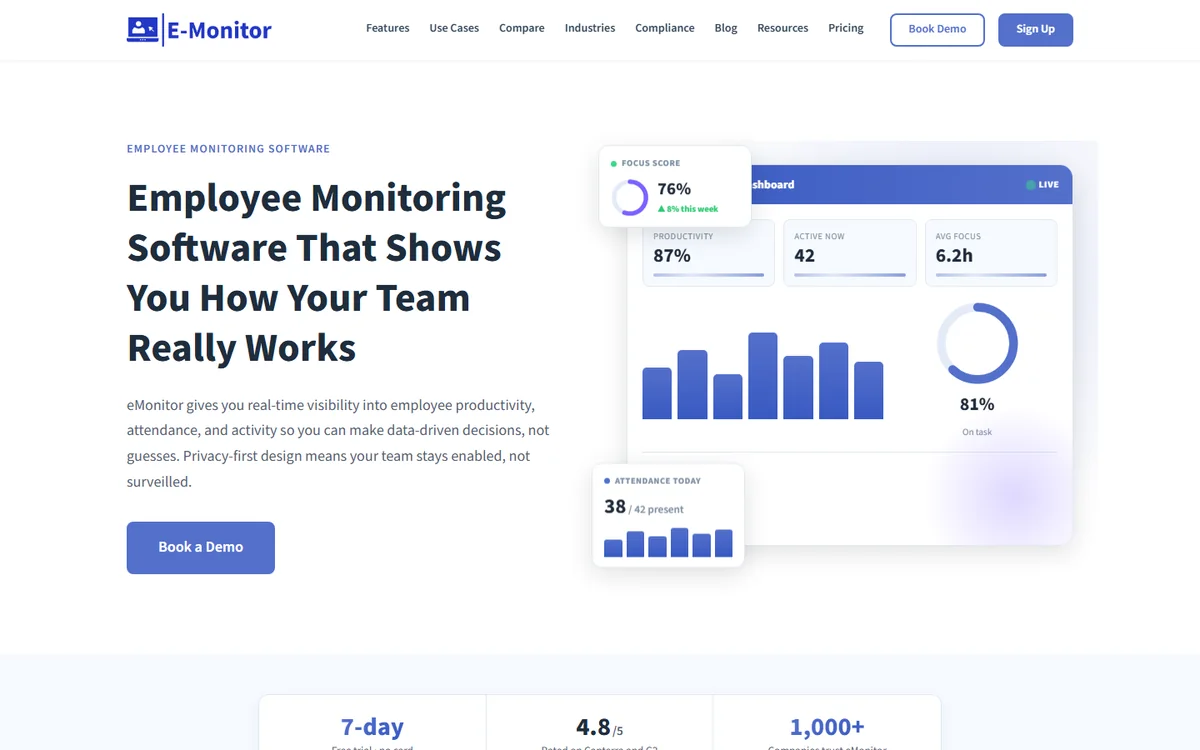
E-Monitor is not a review platform and does not try to be one. It is the layer underneath: the software that records what people actually did, so that when a manager opens Lattice, 15Five or a spreadsheet to write a review, the rating rests on evidence. Its agent on each employee's computer records attendance and active hours, which applications and websites filled them, productivity scores and trends by person and team, and, where enabled, screenshots. Managers see the same data employees see, which turns the review from an argument about impressions into a conversation about a shared record.
The organisations that put E-Monitor first in a performance stack are usually the ones whose previous review cycle produced a complaint: a remote employee rated lower than an office peer with identical output, a manager who could not substantiate a performance improvement plan, or a calibration meeting where nobody had numbers. Our guides to using monitoring data in performance reviews and performance improvement plans cover how to do it defensibly.
Key features
- Productivity monitoring with role-configurable categories, scores and weekly trends
- Time and attendance tracking with active, idle and overtime hours
- Reporting dashboards by individual, team and department, exportable for review cycles
- Employee self-view, so staff see their own data before the review does
- Alerts for sustained productivity drops or after-hours overwork, which surface problems before the cycle
- Windows, macOS, Linux and Chromebook; integrations with BambooHR and others
Pros
- Removes recency and visibility bias from ratings by giving every manager the same record
- Works alongside any platform on this list rather than replacing it
- Lowest price on the list, with the full feature set in the Starter plan
- Rated 4.8 out of 5 on Capterra; more than 1,000 companies
Cons
- No review forms, goal cascades or calibration workflows; pair it with one of the platforms below
- Measures computer-based work; not applicable to roles without a device
- Requires a transparent monitoring policy to be accepted
Pricing: Starter $3.90 per user per month billed annually, Professional $6.90, Enterprise $13.90. 7-day free trial.
2. Lattice: Best for Mid-Market People Teams
Lattice has become the default choice for HR teams at companies of 100 to 2,000 people who want reviews, goals, one-to-ones, feedback and engagement in one well-designed product. Its review cycles are the most configurable in this group, with self, manager, peer and upward components, calibration views that show rating distributions across managers, and templates for growth plans and compensation reviews. Goals and OKRs, engagement surveys and compensation are sold as modules on top of the Performance base.
Key features
- Configurable review cycles with calibration and 9-box views
- One-to-ones with shared agendas, notes and action items
- Goals and OKRs, engagement, compensation and HRIS modules
- Deep integrations with Slack, Teams and major HRIS platforms
Pros
- Polished manager and employee experience that drives adoption
- Strong calibration tooling for larger organisations
- Broad module set lets you grow into the suite
Cons
- Modules add up quickly and an annual minimum applies, so small teams pay more per head
- Price lists have changed several times; quotes vary
Pricing: Performance from about $11 per seat per month on annual billing with an annual minimum; goals, engagement and other modules priced separately.
3. 15Five: Best for Manager-Led Continuous Feedback
15Five is named for its original idea: a weekly check-in that takes an employee fifteen minutes to write and a manager five to read. That check-in, with its pulse questions, priorities and private notes, is still the product's spine, and it is why 15Five suits organisations that want performance management to happen every week rather than every six months. Reviews, 360s, OKRs, one-to-ones, recognition and engagement surveys are built around it, and the manager training content is a genuine differentiator for companies promoting first-time managers.
Key features
- Weekly check-ins with pulse scoring and priorities
- Performance reviews and 360s with calibration
- OKRs, one-to-ones and recognition
- Engagement surveys and manager effectiveness analytics
Pros
- Builds a continuous rhythm managers actually keep
- Manager coaching and training included in higher tiers
- Clear per-user pricing
Cons
- Check-in discipline fades without executive sponsorship
- Reporting is less deep than Lattice or Culture Amp for large organisations
Pricing: Perform about $11 per user per month on annual billing; a lower Engage tier covers surveys only; a Total Platform tier bundles everything.
4. Leapsome: Best for Performance, Learning and Engagement Together
Leapsome's pitch is a people-enablement platform rather than a review tool: reviews, goals and one-to-ones sit next to learning paths, onboarding, engagement surveys and compensation in a modular suite that customers assemble to fit. It is popular with European and international companies, partly for its multilingual support and GDPR posture, and with organisations that want development plans to come out of reviews rather than ratings alone.
Key features
- Reviews, 360s and calibration
- Goals and OKRs with alignment trees
- Learning and onboarding modules linked to development plans
- Engagement surveys, meetings and compensation modules
Pros
- Modular pricing lets you start small
- Development and learning tied to review outcomes
- Strong international and GDPR support
Cons
- Pricing is quoted per module and published figures vary
- Breadth can make initial setup heavier than a reviews-only tool
Pricing: from about $8 per employee per month on annual billing for performance, with modules priced separately on quote.
5. Culture Amp: Best for Engagement-First Organisations
Culture Amp began as an engagement survey platform and remains the category leader there, with benchmark data from thousands of companies and a science team that publishes on what drives retention. Its performance module adds reviews, goals, one-to-ones and continuous feedback, designed so that engagement and performance data can be read together, for example to see whether low-rated teams are also disengaged. It is the choice for organisations that regard culture measurement as the primary job and performance management as part of it.
Key features
- Engagement, pulse, onboarding and exit surveys with industry benchmarks
- Performance reviews, calibration and goals
- Continuous feedback and one-to-ones
- Development plans and skills coaching
Pros
- Best-in-class survey design and benchmarking
- Engagement and performance analysed in one place
- Strong people-science content and support
Cons
- No public pricing; quotes are typically above mid-market competitors
- Performance features are younger than the engagement core
Pricing: custom, billed annually; quoted per employee by module.
6. BambooHR: Best for Small Companies Already on Its HRIS
BambooHR is an HRIS first, and its performance management lives inside it: reviews, goals, one-to-ones, recognition and eNPS surveys that read directly from the employee record. For a company of 20 to 300 people that already runs hiring, onboarding, time off and payroll in BambooHR, adding performance there avoids another vendor, another login and another integration. The review tooling is simpler than the dedicated platforms above, which is a feature for small teams and a limit for large ones.
Related: E-Monitor's BambooHR integration
Key features
- Performance reviews with self and manager assessments and peer feedback
- Goals, one-to-ones and recognition
- eNPS and employee satisfaction surveys
- Everything tied to the BambooHR employee record
Pros
- No separate system to integrate or administer
- Simple enough for managers with no HR training
- Clear tiered pricing
Cons
- Performance requires the Pro tier, so the whole HRIS moves up a tier
- Limited calibration and 360 depth
Pricing: Core about $10 and Pro about $17 per employee per month on annual billing, with performance management in Pro; Elite adds further modules.
7. PerformYard: Best for Straightforward Reviews at a Low Price
PerformYard does one job well: flexible, structured performance reviews without the suite around them. Its forms, cycles, sign-offs and reporting can mirror almost any existing paper or spreadsheet process, which is why it suits organisations in regulated or traditional industries that have a review process they want to keep, not reinvent. Goals, continuous feedback and one-to-ones are included; engagement surveys are an add-on.
Key features
- Highly configurable review forms and cycles
- Goals and continuous feedback
- Sign-off workflows and audit trails
- Reporting on completion, ratings and goal progress
Pros
- Lowest per-user price among the dedicated platforms
- Adapts to existing processes rather than imposing one
- Responsive support included
Cons
- Fewer integrations and less polished than Lattice or 15Five
- Engagement surveys cost extra
Pricing: about $5 to $10 per person per month on annual billing depending on modules.
8. Betterworks: Best for Enterprise OKR Programmes
Betterworks is the specialist for organisations that run on objectives and key results at scale. Its goal alignment, check-ins and conversations are built for cascading thousands of OKRs across divisions, with reviews, calibration and feedback layered on top. It integrates with enterprise HRIS platforms and has invested in AI assistance for writing goals and summarising feedback. It is overkill for a company of 200 and the right tool for a company of 20,000 that has decided OKRs are how it will manage.
Key features
- Enterprise OKR alignment, tracking and reporting
- Reviews, calibration and continuous conversations
- Engagement and feedback tools
- HRIS and productivity-suite integrations
Pros
- Best OKR tooling at enterprise scale
- Mature security and administration
Cons
- Quote-based pricing aimed at large deployments
- Heavier implementation than mid-market tools
Pricing: custom, by quote.
9. Workday: Best for Enterprises on Workday HCM
For an enterprise that runs its people data in Workday HCM, Workday's own performance, talent and goals modules, with Peakon for engagement, are usually the path of least resistance. The review cycle, succession planning, calibration and compensation all read from the same record, and the reporting is as deep as the rest of the platform. The decision is rarely about the performance module in isolation; it is about whether the organisation is a Workday shop.
Key features
- Performance reviews, goals and calibration within HCM
- Talent, succession and compensation planning
- Peakon engagement surveys
- Enterprise reporting and analytics
Pros
- Single record for every people process
- Enterprise-grade security, audit and reporting
Cons
- Only sensible as part of a Workday deployment
- Configuration and change require specialist resources
Pricing: custom, as part of a Workday HCM contract.
How to Choose Performance Management Software
| Your situation | Best fit | Why |
|---|---|---|
| Reviews keep producing disputes about fairness | E-Monitor plus any platform | Objective activity and output data behind every rating |
| Mid-market company building a people function | Lattice | Most complete mid-market suite with strong calibration |
| You want weekly manager rhythm, not annual events | 15Five | Check-in model with manager training |
| Development and learning should follow from reviews | Leapsome | Learning paths linked to review outcomes |
| Engagement measurement is the primary goal | Culture Amp | Category-leading surveys with performance attached |
| Small company already on BambooHR | BambooHR Pro | Performance inside the HRIS, no new vendor |
| Existing review process, tight budget | PerformYard | Flexible forms at the lowest dedicated price |
| Enterprise OKR programme | Betterworks | OKR alignment at scale |
| Enterprise on Workday | Workday | Performance within the existing HCM |
Whatever platform runs the cycle, decide in advance what evidence managers must bring to it. Our guide to how to conduct a performance review sets out a structure, and how to write an employee performance review covers the write-up. Platforms store the conversation; the data that makes it fair has to come from somewhere.
Bring objective data into your next review cycle. E-Monitor records attendance, active hours and productivity trends for every computer-based employee and exports them for any review platform. 7-day free trial, no credit card. Sign up →
Related reading: What Is a Probation Period?, Does Employee Monitoring Hurt Your Employer Brand?.
Frequently Asked Questions
1. What is performance management software?
Software that runs the performance cycle: goal setting and OKRs, continuous feedback, one-to-ones, review cycles with self, manager, peer and upward input, calibration across managers, and reporting on ratings, goals and engagement. Lattice, 15Five, Leapsome, Culture Amp and PerformYard are dedicated platforms; BambooHR and Workday include it in their HR systems.
2. What is the best performance management software in 2026?
For mid-market people teams, Lattice and 15Five; for engagement-led organisations, Culture Amp; for a modular suite with learning, Leapsome; for low-cost structured reviews, PerformYard; for enterprises, Betterworks for OKRs or Workday if already on its HCM. E-Monitor adds the objective productivity data any of them lack.
3. How much does performance management software cost?
Published 2026 prices run from about $5 to $10 per person per month for PerformYard, about $8 for Leapsome's performance module, about $11 for 15Five Perform and Lattice Performance (with an annual minimum), and about $17 per employee for BambooHR's Pro tier. Culture Amp, Betterworks and Workday quote. E-Monitor is $3.90 per user per month.
4. Is E-Monitor a performance management platform?
No. E-Monitor records attendance, active time, application use and productivity trends from employees' computers. It does not run review forms or goal cascades; it supplies the objective data that makes those reviews fair, and it pairs with any of the platforms on this list.
5. Can employee monitoring data be used in performance reviews?
Yes, with a transparent policy, employee access to their own data and judgement applied to context. Activity data shows effort patterns and attendance, not quality, so it should inform the conversation rather than replace it. See our guide to the legal risks of using monitoring data in reviews.
6. Which performance management software is best for small businesses?
BambooHR if you already use its HRIS, PerformYard for low-cost structured reviews, or 15Five if you want a weekly check-in habit. All three are simpler to run than Lattice or Culture Amp at under 100 employees.
7. What is the difference between performance management and employee monitoring software?
Performance management software captures goals, feedback and ratings, which are human judgements. Employee monitoring software captures what happened on work devices: hours, applications, activity and output. The first records opinions; the second records evidence. Organisations increasingly use both.
8. Do these platforms integrate with HRIS systems?
Yes. Lattice, 15Five, Leapsome, Culture Amp, PerformYard and Betterworks integrate with major HRIS platforms for employee records; BambooHR and Workday are HRIS platforms themselves. E-Monitor integrates with BambooHR and others for employee and time-off data.